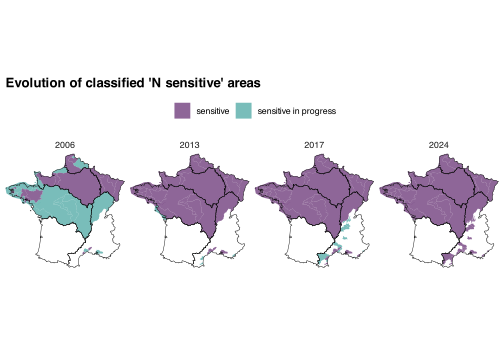
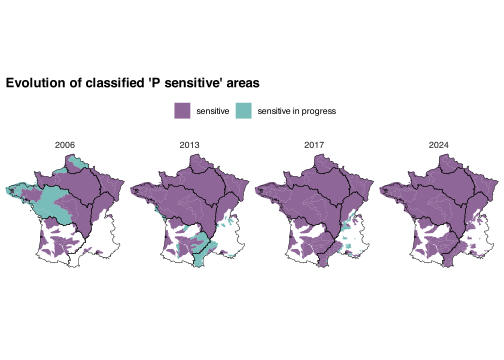
knitr::opts_chunk$set(warning=F, message=F, results=F, dev='svg')library(tidyverse) #loads multiple packages (see https://tidyverse.tidyverse.org/)#core tidyverse packages loaded:# ggplot2, for data visualisation. https://ggplot2.tidyverse.org/# dplyr, for data manipulation. https://dplyr.tidyverse.org/# tidyr, for data tidying. https://tidyr.tidyverse.org/# readr, for data import. https://readr.tidyverse.org/# purrr, for functional programming. https://purrr.tidyverse.org/# tibble, for tibbles, a modern re-imagining of data frames. https://tibble.tidyverse.org/# stringr, for strings. https://stringr.tidyverse.org/# forcats, for factors. https://forcats.tidyverse.org/# lubridate, for date/times. https://lubridate.tidyverse.org/#also loads the following packages (less frequently used):# Working with specific types of vectors:# hms, for times. https://hms.tidyverse.org/# Importing other types of data:# feather, for sharing with Python and other languages. https://github.com/wesm/feather# haven, for SPSS, SAS and Stata files. https://haven.tidyverse.org/# httr, for web apis. https://httr.r-lib.org/# jsonlite for JSON. https://arxiv.org/abs/1403.2805# readxl, for .xls and .xlsx files. https://readxl.tidyverse.org/# rvest, for web scraping. https://rvest.tidyverse.org/# xml2, for XML. https://xml2.r-lib.org/# Modelling# modelr, for modelling within a pipeline. https://modelr.tidyverse.org/# broom, for turning models into tidy data. https://broom.tidymodels.org/# Use the conflicted package (<http://conflicted.r-lib.org/>) to force all conflicts to become errors#loading relevant packageslibrary(cowplot) #for plot_grid() (multiple plots)library(readxl) # to read excel filelibrary(sf) #for spherical geometry operations#at first with sf there was an issues with GDAL and PROJ librairies that were not found. I found the answer here https://github.com/r-spatial/sf/issues/2302 and here https://github.com/r-spatial/sf/issues/2298. I uninstalled the sf package and manually installed it with install.packages('sf', repos = c('https://r-spatial.r-universe.dev')). This changed the version from 1.0-15 to 1.0-16#path for data path_source <-""#setting graphs themetheme_set(theme_minimal() +theme(plot.title =element_text(face="bold") ) )#setting viridis theme for colorsscale_colour_continuous <- scale_colour_viridis_cscale_colour_discrete <- scale_colour_viridis_dscale_colour_binned <- scale_colour_viridis_b#setting viridis theme for fillscale_fill_continuous <- scale_fill_viridis_cscale_fill_discrete <- scale_fill_viridis_dscale_fill_binned <- scale_fill_viridis_b#caption for all graphsSource <-"Source: data.europa.eu\ncomputation by Thomas Starck"
link to the decrees defining the sensitive zones. Go to TEXTES TECHNIQUES RELATIFS A L’ASSAINISSEMENT COLLECTIF -> 2.1. Arrêtés de délimitation
1994 ministerial ruling, November 23. No quantitative objectives, just says that for WWTP discharging more than 600 kg of organic pollution per day, the prefect gives goals of reduction. Refers to the 1994, June 3 decree whose article 6 which says that in water bodies sensitive to eutrophication, nitrogen and phosphorus discharges must be reduced.
We load the geographical borders of the 6 water agencies.
Code
#load water agencies border data shapefilebasins <- sf::st_read("source_data/maps/water_agencies/simplified_CircAdminBassin2021/CircAdminBassin2021.shp")#focus on metropolebasins_metropole <- basins %>%#keep only metropolitan basinsfilter( NumCircAdm %in%c("01", "02", "03", "04", "05", "06") ) %>%#remove useless columnsselect(basin_name = NomCircAdm, basin_num = NumCircAdm ) %>%#change name to be similar to the other filesmutate(basin_name =case_when( basin_name =="ADOUR-GARONNE"~"Adour-Garonne", basin_name =="ARTOIS-PICARDIE"~"Artois-Picardie", basin_name =="LOIRE-BRETAGNE"~"Loire-Bretagne", basin_name =="RHIN-MEUSE"~"Rhin-Meuse", basin_name =="RHONE-MEDITERRANEE"~"Rhone-Méditerranée", basin_name =="SEINE-NORMANDIE"~"Seine-Normandie" ) )#keep only metropolitan datarm(basins)
We load the data of the sensitive zones and focus only on metropolitan France. The European file gives us the geographical areas, the sanitation portal file adds data about the “conformity date” besides the “decree date”.
Code
#load EU geographical data about sensitive zones (shapefile)file_sensitive_zones <- sf::st_read("source_data/maps/sensitive_zones/ZoneSensible_FRA_ZRPE_2.shp") %>%#more explicit name, also used in file below, used to merge the 2 filesrename(EU_code_zone = CdEuZS)#load French spreadsheet, gives addictional info on conformity dates and so onfile_sanitation_portal <-read_excel("source_data/maps/sensitive_zones/Export_ZS_2020_05_29-1.xlsx", range ="A1:I142") %>%#more explicit name, also used in file above, used to merge the 2 filesrename(EU_code_zone =`Code-européen CM* - CA*`) %>%#add water agencies namesmutate(basin =case_when(substr(code_national, 1, 2) =="01"~"Artois-Picardie",substr(code_national, 1, 2) =="02"~"Rhin-Meuse",substr(code_national, 1, 2) =="03"~"Seine-Normandie", substr(code_national, 1, 2) =="04"~"Loire-Bretagne",substr(code_national, 1, 2) =="05"~"Adour-Garonne",substr(code_national, 1, 2) =="06"~"Rhône-Méditerranée", T~"Overseas" ) )#merging the 2 filestemp <-merge( file_sensitive_zones, file_sanitation_portal, by="EU_code_zone" )#keeping columns of interest from each of the 2 filestemp <- temp %>%select(#sanitation portal file EU_code_zone, code_national, nom, nom_court, traitement_requis, basin, date_arrêté_N, date_arrêté_P, date_conformité_N, date_conformité_P,#EU file gml_id, gid, NomZS, NomCourtZS, StZS, timePositi, CdTraiteme, LbTraiteme, DateLimite, CdTypeZone, MnTypeZone, LbTypeZone, DatePubliT, #date of decree for P sensitive zone ? DateLimi_1, #date of decree for N sensitive zone ? DatePubl_1, ComZS )#final filesensitive_zones <- temp %>%select( basin,P_decree_date = date_arrêté_P, N_decree_date = date_arrêté_N,P_conformity_date = date_conformité_P, N_conformity_date = date_conformité_N,sensitive_type = LbTraiteme,name_sensitive_zone = NomZS,name_sensitive_zone_simple = NomCourtZS,id_sensitive_zone = gid, geometry )rm(temp)#remove non-metropolitan sensitive zonesmetropole <-function(map_sf){ map_sf <- map_sf %>%filter(!id_sensitive_zone %in%c(14, 15, 16, 17, 18, 137, 138, 139, 140, 141))return(map_sf)}sensitive_zones <-metropole(sensitive_zones)#color scale for basinsbasin_colors <-c("#440154", "#414487", "#2a788e", "#7ad151", "#22a884", "#fde725")basin_names <-c("Seine-Normandie", "Loire-Bretagne", "Artois-Picardie", "Adour-Garonne", "Rhin-Meuse", "Rhône-Méditerranée")sensitive_zones$basin <-factor( sensitive_zones$basin, levels =c("Seine-Normandie","Loire-Bretagne","Artois-Picardie","Rhin-Meuse","Adour-Garonne", "Rhône-Méditerranée" ) )
Sensitive areas
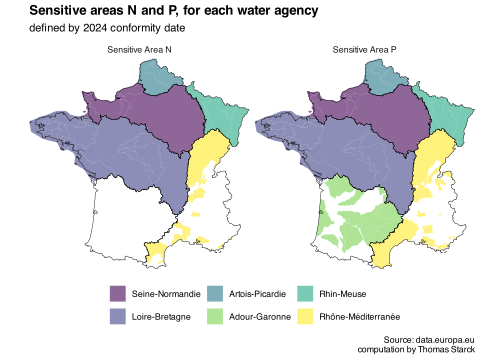
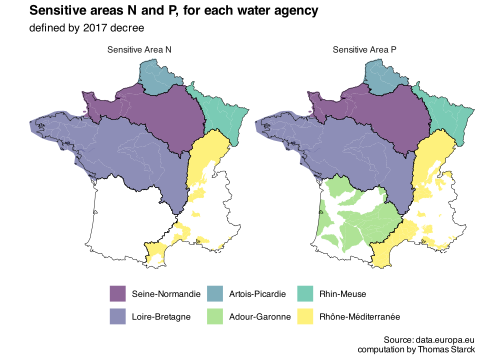
Logically, the cards below in the 2 panes are identical, because the 2017 decree sets the 2024 to reach conformity.
draw_map_2024_conformity <-function(sensitive_zones, basins_metropole){ temp <- sensitive_zones %>%select( basin,`Sensitive Area P`=P_conformity_date,`Sensitive Area N`=N_conformity_date, geometry ) %>%gather(N_or_P, date, `Sensitive Area P`, `Sensitive Area N`) %>%filter(is.na(date)==F) p <-ggplot(temp) +geom_sf(aes(fill=basin), color =NA, size=0, alpha=.6 ) +geom_sf(data = basins_metropole, color ="black", fill=NA, ) +scale_fill_manual(values = basin_colors, labels=basin_names, breaks=basin_names ) +coord_sf(datum =NA, expand =FALSE) +#remove coordinatestheme(panel.background =element_blank(),legend.position ="bottom" ) +facet_wrap(vars(N_or_P)) +labs(title ="Sensitive areas N and P, for each water agency",subtitle ="defined by 2024 conformity date",caption = Source,fill="" )return(p)}draw_map_2024_conformity(sensitive_zones, basins_metropole)
Code
draw_map_2017_decree <-function(sensitive_zones, basins_metropole){ temp <- sensitive_zones %>%select( basin,`Sensitive Area P`=P_decree_date,`Sensitive Area N`=N_decree_date, geometry ) %>%gather(N_or_P, date, `Sensitive Area P`, `Sensitive Area N`) %>%filter(is.na(date)==F) p <-ggplot(temp) +geom_sf(aes(fill=basin), color =NA, size=0, alpha=.6 ) +geom_sf(data = basins_metropole, color ="black", fill=NA, ) +scale_fill_manual(values = basin_colors, labels=basin_names, breaks=basin_names ) +coord_sf(datum =NA, expand =FALSE) +#remove coordinatestheme(panel.background =element_blank(),legend.position ="bottom" ) +facet_wrap(vars(N_or_P)) +labs(title ="Sensitive areas N and P, for each water agency",subtitle ="defined by 2017 decree",caption = Source,fill="" )return(p)}draw_map_2017_decree(sensitive_zones, basins_metropole)
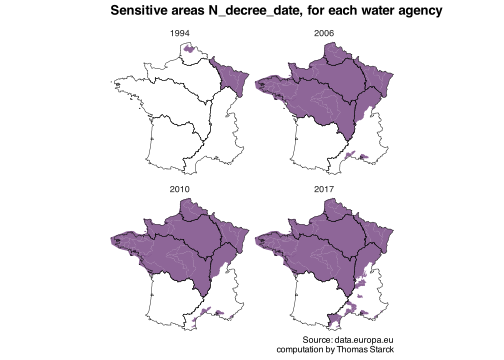
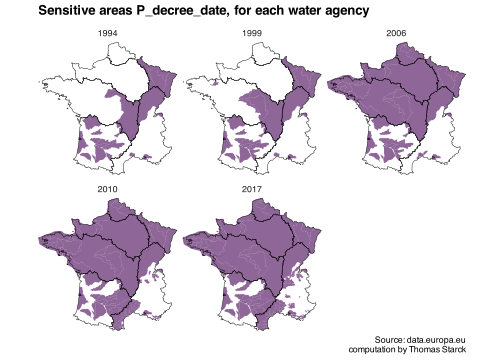
Evolution, by decree date
Code
# Define the expand_sensitive_zones functionexpand_sensitive_zones <-function(df, date_column) { df <- df %>%st_drop_geometry()# Create a vector of unique id_sensitive_zone unique_zones <- df %>%filter(!is.na(.data[[date_column]])) %>%# Use .data to access the column by namedistinct(id_sensitive_zone) %>%pull()# Initialize an empty data frame to store the expanded rows expanded_df <-data.frame(id_sensitive_zone =character(),date =as.Date(character()) )# Loop through each unique id_sensitive_zone and their corresponding datefor (zone in unique_zones) {# Get the date of the sensitive zone date_id <- df[df$id_sensitive_zone == zone, date_column]# Get unique dates greater or equal to the date of the sensitive zone unique_dates <-na.omit(unique(df[, date_column][df[, date_column] >= date_id]))# Create rows for (id_sensitive_zone, date_i) combinations new_rows <-data.frame(id_sensitive_zone = zone, date = unique_dates)# Add the new rows to the expanded data frame expanded_df <-rbind(expanded_df, new_rows) }return(expanded_df)}
Code
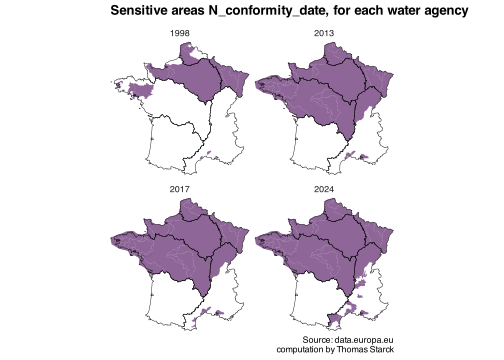
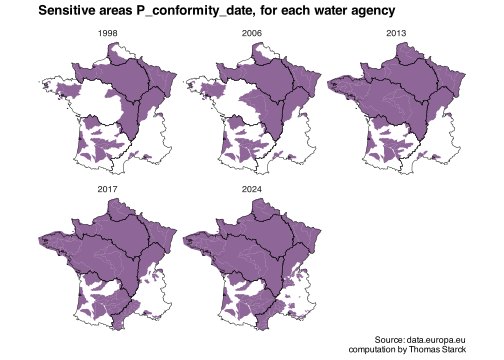
draw_map_decree <-function(sensitive_zones, basins_metropole, date_column){ temp <- sensitive_zones %>%filter(!is.na(.data[[date_column]])) p <-ggplot(temp) +geom_sf(fill ="#440154", size=0, alpha=.6, color="NA" ) +geom_sf(data = basins_metropole, color ="black", fill=NA, ) +scale_fill_manual(values = basin_colors, labels=basin_names, breaks=basin_names ) +coord_sf(datum =NA, expand =FALSE) +theme(panel.background =element_blank() ) +facet_wrap(vars(year(.data[[date_column]]))) +labs(title =paste("Sensitive areas ", date_column, ", for each water agency", sep=""),caption = Source )return(p)}
# Call the function with the "N_decree_date" columnexpanded_df_N <-expand_sensitive_zones(sensitive_zones, "N_conformity_date")# Get geometry and transform to sf file for N_decree_dateexpanded_sf_N <-st_as_sf(left_join( expanded_df_N %>%rename(N_conformity_date = date), sensitive_zones %>%select(-N_conformity_date),by ="id_sensitive_zone" ))
# Load necessary librarieslibrary(jpeg)library(png)#boundaries of France, to have the png and jpg maps at scale next to our map# Calculate the bounding boxbbox <-st_bbox(expanded_sf_N)# Set the plot extentsxmin <- bbox$xminxmax <- bbox$xmaxymin <- bbox$yminymax <- bbox$ymax
Code
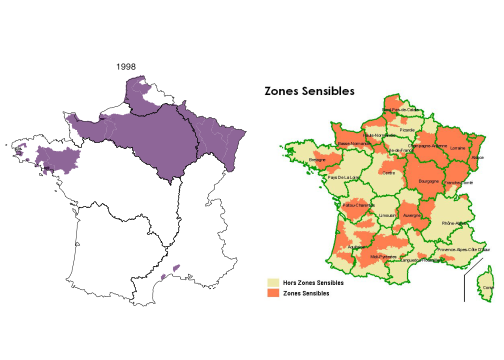
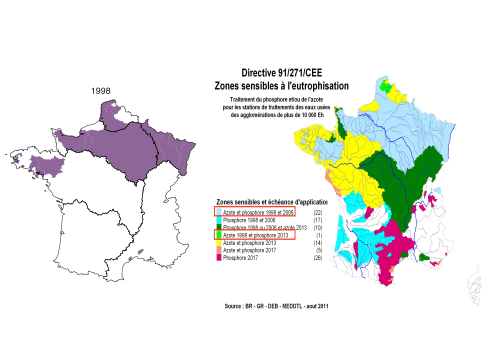
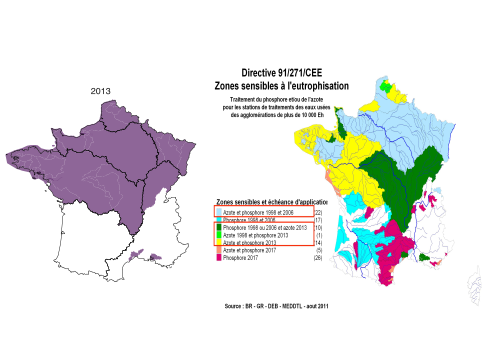
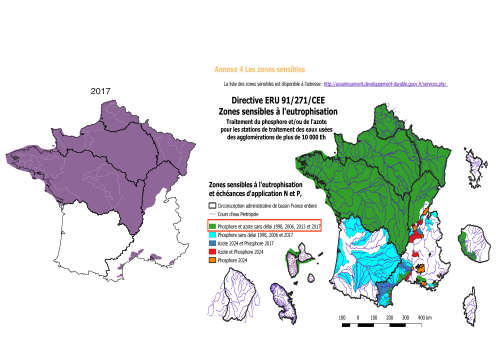
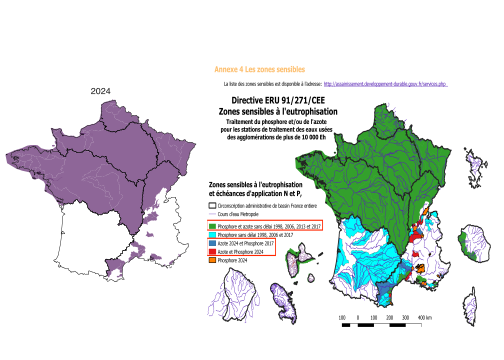
side_by_side_maps <-function(map_image, year, rel_w1, rel_w2, date_column){# Create sensitive zones maps for the year gg <-draw_map_decree( expanded_sf_N %>%filter(year(expanded_sf_N[[date_column]])==year), basins_metropole, date_column ) +labs(title ="", caption ="")# Create a ggplot2 plot with the JPEG image annotation gg_1 <-ggplot() +annotation_raster(map_image, xmin = xmin, xmax = xmax, ymin = ymin, ymax = ymax) +coord_sf(xlim =c(xmin, xmax), ylim =c(ymin, ymax), expand=F, crs=st_crs(expanded_sf_N), datum=NA) #2 maps side by side combined_plots <-plot_grid( gg, gg_1, nrow =1, rel_widths =c(rel_w1, rel_w2), axis="tblr", align ="hv" )return(combined_plots)}
# Call the function with the "N_decree_date" columnexpanded_df_P <-expand_sensitive_zones(sensitive_zones, "P_conformity_date")# Get geometry and transform to sf file for N_decree_dateexpanded_sf_P <-st_as_sf(left_join( expanded_df_P %>%rename(P_conformity_date = date), sensitive_zones %>%select(-P_conformity_date),by ="id_sensitive_zone" ))
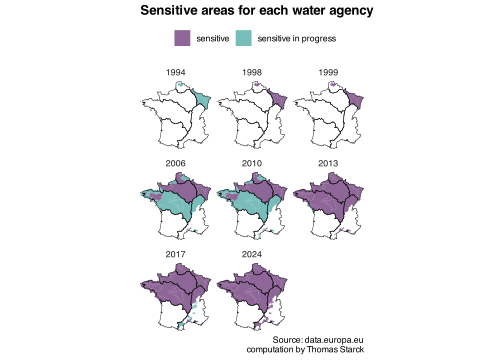
draw_map_effectively_sensitive <-function(data, basins_metropole, N_or_P_sensitivity){ data <- data %>%filter({{ N_or_P_sensitivity }} !="non sensitive") data p <-ggplot(data) +geom_sf(aes(fill={{ N_or_P_sensitivity }}),size=0, alpha=.6, color=NA ) +scale_fill_manual(values =c("sensitive"="#440154", "sensitive in progress"="#21918c"),limits =c("sensitive", "sensitive in progress") #to display all the colors in legend, even when not present in data (for year by year gif) ) +geom_sf(data = basins_metropole, color ="black", fill=NA, ) +coord_sf(datum =NA, expand =FALSE) +theme(panel.background =element_blank(),legend.position ="top" ) +facet_wrap(~Year) +labs(title ="Sensitive areas for each water agency",caption = Source,fill="" )return(p)}