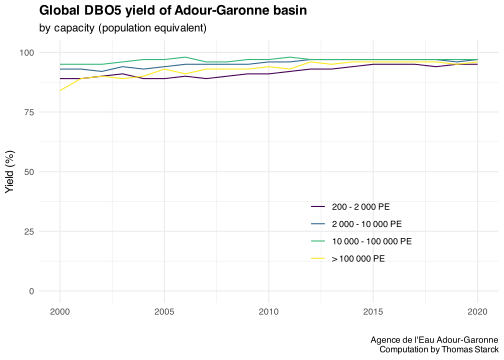
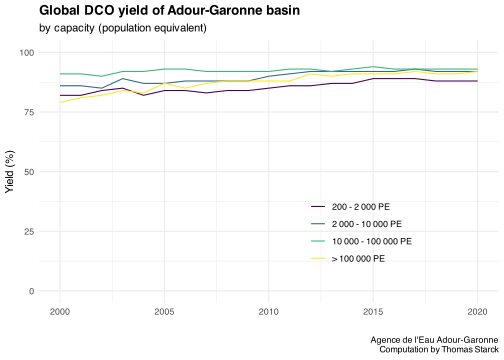
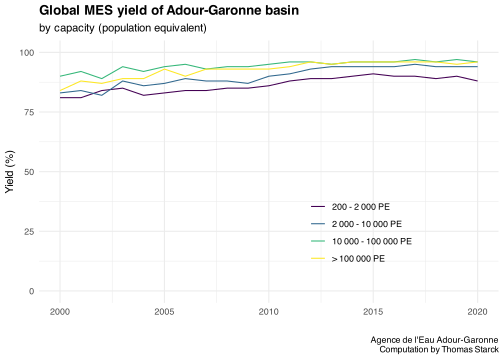
Adour-Garonne

Code
knitr::opts_chunk$set(warning=F, message=F, results=F, dev='svg')

library(tidyverse) #loads multiple packages (see https://tidyverse.tidyverse.org/)

#core tidyverse packages loaded:
# ggplot2, for data visualisation. https://ggplot2.tidyverse.org/
# dplyr, for data manipulation. https://dplyr.tidyverse.org/
# tidyr, for data tidying. https://tidyr.tidyverse.org/
# readr, for data import. https://readr.tidyverse.org/
# purrr, for functional programming. https://purrr.tidyverse.org/
# tibble, for tibbles, a modern re-imagining of data frames. https://tibble.tidyverse.org/
# stringr, for strings. https://stringr.tidyverse.org/
# forcats, for factors. https://forcats.tidyverse.org/
# lubridate, for date/times. https://lubridate.tidyverse.org/

#also loads the following packages (less frequently used):
# Working with specific types of vectors:
#     hms, for times. https://hms.tidyverse.org/
# Importing other types of data:
#     feather, for sharing with Python and other languages. https://github.com/wesm/feather
#     haven, for SPSS, SAS and Stata files. https://haven.tidyverse.org/
#     httr, for web apis. https://httr.r-lib.org/
#     jsonlite for JSON. https://arxiv.org/abs/1403.2805
#     readxl, for .xls and .xlsx files. https://readxl.tidyverse.org/
#     rvest, for web scraping. https://rvest.tidyverse.org/
#     xml2, for XML. https://xml2.r-lib.org/
# Modelling
#     modelr, for modelling within a pipeline. https://modelr.tidyverse.org/
#     broom, for turning models into tidy data. https://broom.tidymodels.org/

# Use the conflicted package (<http://conflicted.r-lib.org/>) to force all conflicts to become errors

#loading additional relevant packages
library(cowplot) #for plot_grid()
library(viridis) #for viridis colors

#path for data 
path_source <- "source_data/05_adour_garonne/"
path_output <- "output_data/STEU/Adour_Garonne/"

Year_analysis <- 2020

#setting graphs theme
theme_set(
  theme_minimal() +
    theme(
      plot.title = element_text(face="bold")
      )
  )

#for captions below graphs
Source <- "Agence de l'Eau Adour-Garonne\nComputation by Thomas Starck"


#setting viridis theme for colors
scale_colour_continuous <- scale_colour_viridis_c
scale_colour_discrete   <- scale_colour_viridis_d
scale_colour_binned     <- scale_colour_viridis_b
#setting viridis theme for fill
scale_fill_continuous <- scale_fill_viridis_c
scale_fill_discrete   <- scale_fill_viridis_d
scale_fill_binned     <- scale_fill_viridis_b

# Load the function file
source("functions.R")

Source and data

Informations about the Adour-Garonne basin can be found in the “Etat des lieux” (Status report) in 2019 and 2013.

In 2018, the basin had 7.86 M inhabitants “Out of 7M habitants, 30% live in scattered housings”. We consider these people are not connected to sewers and are in Individual Autonomous Systems (IAS).

More information in the Guide de l’eau (here and here), and on the basin website, or here.

The data are available on the Système d’Information sur l’Eau du bassin Adour-Garonne.

Two kinf of files are downloaded : one concerns pollution discharge and their location for each year (here), the other provides information about the waste water treatment plants characteristics (here).

There are 2 main files for each year (and also pdf files describing the variables). To see more details about the different points (A1, A2…), see here.

listObj_YEAR : these files describe the characteristics of the WWTP and networks.

listDataIndicateurs : these files describe the different flows, with 2 main variables, “indicator” and “parameter”. It also specified type_rj, whether it is RJ (“Point de rejet du système de traitement”, i.e. discharge by WWTP) or SC (“Système de collecte, direct dans le milieu naturel”, i.e. discharge by sewers)

indicators :

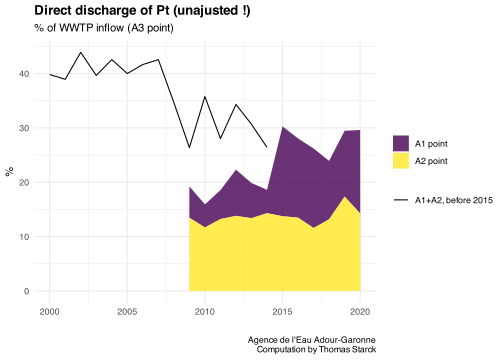
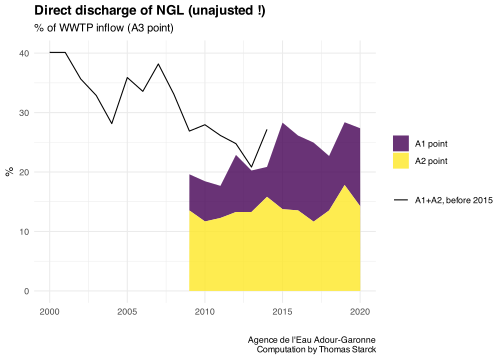
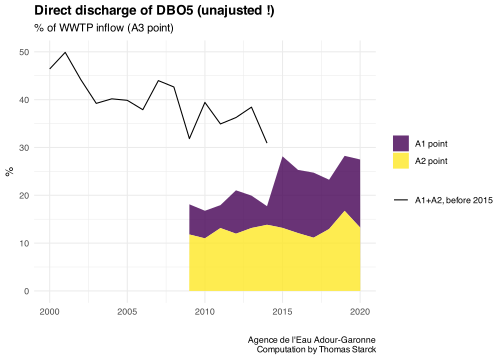
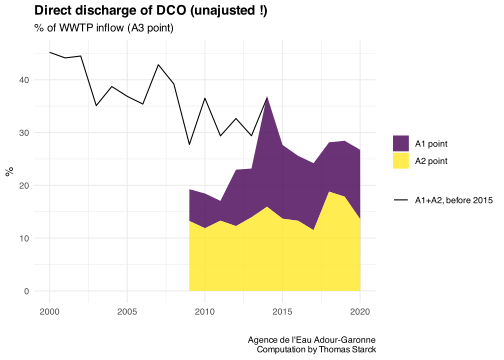
  • PORDO “Pollution déversée par le système de collecte représentative d’un jour moyen du mois considéré (issue de l’autosurveillance (Kg/j)”. Only starting 2009. Associated with type_rj=RJ. We assimilate this to the A1 point, i.e. discharge by sewers, and rename it ._collection_discharge.
  • PORBP “Pollution by-passée en tête de station représentative d’un jour moyen du mois considéré (issue de l’autosurveillance (Kg/j)”. Associated with type_rj RJ. We assimilate this to the A2 point, i.e. last discharge point before the WWTP, and rename it ._head_by_pass.
  • PORMX “Pollution estimée rejetée directement par le système de collecte (si pas de station d’épuration ou pas de mesures sur DO ou By-pass)”. Only before 2015. Associated with type_rj RJ, but before 2007 also associated to SC. This is an estimation of A1+A2 points discharge before 2015, and rename it ._discharge_estimate.
  • POENT “Pollution mesurée entrante en station (Kg/j)”. We assimilate this to the A3 point, i.e. pollution inflow to WWTP.
  • POSOR “Pollution mesurée en sortie de station d’épuration”. We assimilate this to the A4 point, i.e. pollution outflow of WWTP.
  • PLUIE “Pluie mesurée (mm)”. Rain in mm. We do not analyse this.
  • BOUE “Quantité de boues produite et évacuée”. Quantity of sludge produced, we do not analyse it.
  • A2. Not described, but always associated to the parameter NBJDV “nombre de jours de déversement”, not reported before 2018. Associated with type_rj RJ. This is the nb of days (per month) where discharge on A2 point occurs.
  • PODMI Not described, but just from 2000 to 2007. Associated with the parameters nutrients (MES, Pt, NGL…) and only with type_rj SC (not RJ). We do not analyse it.
  • POIMI same as PODMI, but also associated with VOL. We do not analyse it.

parameters :

  • the nutrients : “NO2” “MES” “NTK” “DBO5” “NGL” “NO3” “PT” “DCO” “NH4”, in kg/day
  • volume “VOL” in m3/day
  • rainfall “PLUIE” in mm
  • “NBJDV” “Nombre de jours de déversement”. Associated with type_rj RJ. For 2015-2020, associated with the indicator PORDO. Also associated with A2 for 2018-2020.This is the nb of days (per month) where discharge on A1 or A2 point occurs.
  • and the sludge production and destination in kg of dry matter per year : production “PROD”, spread “U”, composted (before 2013) “C”, composted normalized “C1”, composted non normalized “C2”, landfilled “S”, in transition “T”, incinerated “I”, to other WWTP, “STEP”. We do not analise it.

type_rj SC is only associated to PORMX, PODMI and POIMI, from 2000 to 2007.

We load the pollutions in the listDataIndicateurs files, for each year.

Code
#loading all years, for pollutions (by discharge code name)
file_adour_garonne <- 
  list.files( 
    #read and merge csv of all years
    path = path_source,
    pattern = "listeDataIndicateurs*", 
    full.names = T, 
    recursive = T
    ) %>% 
  lapply(read_delim, delim = ";") %>% 
  bind_rows
Code
#Spotting duplicates observation of the quadruplets (code_rj, indicateur, parametre, annee)
temp <- file_adour_garonne %>% select(code_rj, annee, indicateur, parametre) #selects quadruplets
temp$duplicated <- duplicated(temp) #spots duplicates
temp <- temp %>% filter(duplicated == T) #filters duplicates
temp <- left_join(temp, file_adour_garonne) #exctract dupplicates informations from main file
nrow(temp) #number of rows 200 (so 100 unique observations)
unique(temp$code_rj) #spots the unique code_rj duplicated (only 3)

# We remove SERRES-MORLAAS and ST AULAYE (Bourg)
file_adour_garonne <- subset(file_adour_garonne, !(code_rj %in% c("0564520V0011", "0524376V0021")))
# We remove LAVAUR just for 2000
file_adour_garonne <- subset(file_adour_garonne, !(code_rj == "0581140V0041" & annee == "2000"))

In the listDataIndicateurs files, which reports pollution at the discharge points, there are 100 pollution observations (code_rj) that are reported twice, concerning 3 waste water treatment plants.

  • SERRES-MORLAAS in 2018, 2019 and 2020 (code_rj 0564520V0011), capacity of 850 population equivalent. Negligible, we completely remove it.
  • ST AULAYE (Bourg) in 2018 (code_rj 0524376V0021), capacity of 1 200 population equivalent. Negligible, we completely remove it.
  • LAVAUR in 2000 (code_rj 0581140V0041), capacity of 10 000 population equivalent => We remove Lavaur just for this year since its a rather big town.

Then we load the WWTP descriptions in the listeObj files, for each year.

Code
#for 2010-2020, the files are reported in multiple folders : we load each file, add the year, and merge them
f_load_WWTP_2010_2020 <- function (year_min, year_max){
  path <- "source_data/05_adour_garonne/donnees_rejets_collectivites_"
  #intialization
  temp <- 
    read_csv2(
      paste0(path, as.character(year_min), "/listeObj.csv"),
      #we have to specify the columns types, otherwise some problems
      col_types = cols(
        debit_nominal_tps_pluie="numeric",
        insee_commune="character",
        insee_commune_step="character"
        )
      ) %>%
    #adding the year
    mutate(annee=year_min)
  #loop
  for (i in (year_min+1):year_max){
    temp2 <- 
      read_csv2(
        paste0(path, as.character(i), "/listeObj.csv"),
        col_types = 
          #we have to specify the columns types, otherwise some problems
          cols(
            debit_nominal_tps_pluie="numeric",
            insee_commune="character",
            insee_commune_step="character"
            )
        ) %>%
      #adding the year
      mutate(annee=i)
    temp <- bind_rows(temp, temp2)
  }
  return(temp)
}
file_WWTP_2010_2020 <- f_load_WWTP_2010_2020(2010, 2020) %>% distinct()

#for 2000-2009, files are reported in one unique folder ; we load each file, add the year, merge them
f_load_WWTP_2000_2009 <- function (year_min, year_max){
  path <- "source_data/05_adour_garonne/donnees_rejets_collectivites_2000_2009/listeObj.csv"
  temp <- 
    read_csv2(path) %>%
    mutate(annee=year_min)
  for (i in (year_min+1):year_max){
    temp2 <- 
      read_csv2(path) %>%
      mutate(annee=i)
    temp <- bind_rows(temp, temp2)
  }
  return(temp)
}
file_WWTP_2000_2009 <- f_load_WWTP_2000_2009(2000, 2009) %>% distinct()

#we merge the files for 2000-2009 and 2010-2020
file_WWTP <- bind_rows(
  file_WWTP_2000_2009, file_WWTP_2010_2020
)
Code
WWTP <- file_WWTP %>%
  select(
    #we select and rename in standard denomination the variables of interest
    Year = annee,
    code_discharge = code_rj,
    code_WWTP = code_step,
    name_WWTP = nom_step,
    INSEE_COM = insee_commune_step, #commune of the WWTP : possible to also have commune of discharge location
    name_commune = nom_commune_step, #commune of the WWTP : possible to also have commune of discharge location
    capacity = capacite, # in population equivalent
    network_type = nature_reseau,
    treatment_type = traitement_principal,
    long_WWTP = x_step,
    lat_WWTP = y_step,
    long_discharge = x_rj,
    lat_discharge = y_rj,
    discharge_location = milieu_recepteur
    #possible to get : water nominal flow (dry and wet weather)
    #possible to get : nominal load DBO5, DCO, MES
    #other variables (type_rj...) not selected because already in file_adour_garonne, merged after
  )

#transform monthly values into annual values, drops monthly values
N_P_adour_garonne <-  file_adour_garonne %>% 
  rename(
    Year = annee,
    code_discharge = code_rj
    ) %>%
  mutate(valeur = rowMeans(.[7:18], na.rm = T)) %>% #annual mean over the 12 months
  select(!(valeur_01:valeur_12)) #drops monthly values

N_P_adour_garonne <- N_P_adour_garonne %>%
  #sludge values put with other values
  mutate(valeur = 
           case_when(
             is.na(valeur_y) == F ~ valeur_y, 
             T ~ valeur
             )
         ) %>%
  #drops useless columns of sludge
  select(-valeur_y) %>% 
  #replace NAN (issued from rowMean) into NA
  mutate_all(~ifelse(is.nan(.), NA, .)) %>%
  #preparing standard renaming for columns
  mutate(
    #rename PT in Pt
    parametre = case_when(
      parametre == "PT" ~ "Pt",
      T ~ parametre
    )
  ) %>%
  filter(
    #"PLUIE" not selected for now ; PORMX neither (data before 2015)
    (indicateur %in% c("POENT", "POSOR", "PORDO", "PORBP", "BOUE", "A2", "PORMX")) & 
      (parametre %in% c("NGL", "NTK", "NH4", "NO2", "NO3", "Pt", "DBO5", "DCO", "MES", "VOL",
                        #for now only sludge production, not destination (U, I, S...)
                        "PROD",
                        #nb of days of discharge
                        "NBJDV"))
  ) %>%
  #rename for concatenation
  mutate(
    indicateur = case_when(
      indicateur == "POENT"  ~ "in", #A3 point
      indicateur == "POSOR"  ~ "out", #A4 point
      indicateur == "PORDO"  ~ "collection_discharge", #A1 point
      indicateur == "PORBP"  ~ "head_by_pass", #A5 point (and A2 ?)
      indicateur == "BOUE"  ~ "sludge", #A6 point
      indicateur == "A2"  ~ "A2", #A2 point
      indicateur == "PORMX"  ~ "discharge_estimate", #A1 point (and A2 point ?) before 2015 if no measure
      ),
    parametre = paste(parametre, indicateur, sep="_")
    ) %>%
  select(-indicateur) %>% 
  spread(key = parametre, value = valeur) 
Code
#Spotting duplicates observation of the doublets (code_rj, Year)
temp <- WWTP %>% select(code_discharge, Year) #selects quadruplets
temp$duplicated <- duplicated(temp) #spots duplicates
temp <- temp %>% filter(duplicated == T) #filters duplicates
temp <- left_join(temp, WWTP) #exctract dupplicates informations from main file
unique(temp$code_discharge) #spots the unique code_discharge duplicated (only 7)

For the listObj files, which reports WWTP characteristics, there are 7 discharge codes that are reported twice (under 2 different WWTP codes) :

  • 0531555V0181, TOULOUSE (GINESTOUS G1), 950 000 (or 400 000) population equivalent
  • 0516345V0011, ST QUENTIN SUR CHARENTE (Barrage Lavaud village), 100 population equivalent
  • 0581140V0041, LAVAUR, 13 000 (or 8 000) population equivalent
  • 0587034V0031, CHAMPAGNAC LA RIVIERE (le Bourg ), 230 population equivalent
  • 0563047V0011, LA BOURBOULE, 30 000 population equivalent
  • 0524376V0021, ST AULAYE (BOURG), 1350 (or 1200) population equivalent
  • 0564520V0011, SERRES-MORLAAS, 8500 population equivalent

On the portail assainissement we check the WWTP code (Code SANDRE) which is unique to decide which one of the 2 to keep. The kept ones are:

See cleaning process
  • 0531555V018 for TOULOUSE (GINESTOUS G1), (removed : 0531555V001)
  • 0516345V001 for ST QUENTIN SUR CHARENTE (Barrage Lavaud village), (removed : 0416345S0001)
  • 0581140V004 for LAVAUR, (removed : 0581140V001)
  • 0487034V003 for CHAMPAGNAC LA RIVIERE (le Bourg ), (removed : 0487034S0003)
  • 0463047S0001 for LA BOURBOULE, (removed : 0563047S0001)
  • 0524376V004 for ST AULAYE (BOURG) (removed : 0524376V002)
  • 0564520V002 for SERRES-MORLAAS (removed : 0564520V001). But the reported capacity is inconsistent (8500 instead of 850), so we remove this WWTP.
Code
WWTP <- subset(WWTP, !(code_WWTP %in% c("0531555V001", "0416345S0001", "0581140V001", "0487034S0003", "0563047S0001", "0524376V002")))
WWTP <- subset(WWTP, code_discharge != "0564520V0011") #completely remove SERRES-MORLAAS

Now we join the 2 files (WWTP description and pollution flows)

Code
#merge with WWTP characteristics
N_P_adour_garonne <- left_join(N_P_adour_garonne, WWTP, by=c("Year", "code_discharge"))

Finally, for 2000-2019 (not for 2020), WWTP capacities are over reported by a factor 10. We fix this.

Code
N_P_adour_garonne$capacity[N_P_adour_garonne$Year < 2020] <- N_P_adour_garonne$capacity[N_P_adour_garonne$Year < 2020]/10

When nutrient flows are negative or null, we replace them by empty values.

Code
# Some reported flows are negative or null. We replace them with empty values.
#Pt
N_P_adour_garonne$Pt_in[N_P_adour_garonne$Pt_in <= 0] <- NA
N_P_adour_garonne$Pt_out[N_P_adour_garonne$Pt_out <= 0] <- NA
N_P_adour_garonne$Pt_collection_discharge[N_P_adour_garonne$Pt_collection_discharge <= 0] <- NA
N_P_adour_garonne$Pt_head_by_pass[N_P_adour_garonne$Pt_head_by_pass <= 0] <- NA
#DBO5
N_P_adour_garonne$DBO5_in[N_P_adour_garonne$DBO5_in <= 0] <- NA
N_P_adour_garonne$DBO5_out[N_P_adour_garonne$DBO5_out <= 0] <- NA
N_P_adour_garonne$DBO5_collection_discharge[N_P_adour_garonne$DBO5_collection_discharge <= 0] <- NA
N_P_adour_garonne$DBO5_head_by_pass[N_P_adour_garonne$DBO5_head_by_pass <= 0] <- NA
#DCO
N_P_adour_garonne$DCO_in[N_P_adour_garonne$DCO_in <= 0] <- NA
N_P_adour_garonne$DCO_out[N_P_adour_garonne$DCO_out <= 0] <- NA
N_P_adour_garonne$DCO_collection_discharge[N_P_adour_garonne$DCO_collection_discharge <= 0] <- NA
N_P_adour_garonne$DCO_head_by_pass[N_P_adour_garonne$DCO_head_by_pass <= 0] <- NA
#MES
N_P_adour_garonne$MES_in[N_P_adour_garonne$MES_in <= 0] <- NA
N_P_adour_garonne$MES_out[N_P_adour_garonne$MES_out <= 0] <- NA
N_P_adour_garonne$MES_collection_discharge[N_P_adour_garonne$MES_collection_discharge <= 0] <- NA
N_P_adour_garonne$MES_head_by_pass[N_P_adour_garonne$MES_head_by_pass <= 0] <- NA
#NTK
N_P_adour_garonne$NTK_in[N_P_adour_garonne$NTK_in <= 0] <- NA
N_P_adour_garonne$NTK_out[N_P_adour_garonne$NTK_out <= 0] <- NA
N_P_adour_garonne$NTK_collection_discharge[N_P_adour_garonne$NTK_collection_discharge <= 0] <- NA
N_P_adour_garonne$NTK_head_by_pass[N_P_adour_garonne$NTK_head_by_pass <= 0] <- NA
#NO3
N_P_adour_garonne$NO3_in[N_P_adour_garonne$NO3_in <= 0] <- NA
N_P_adour_garonne$NO3_out[N_P_adour_garonne$NO3_out <= 0] <- NA
N_P_adour_garonne$NO3_collection_discharge[N_P_adour_garonne$NO3_collection_discharge <= 0] <- NA
N_P_adour_garonne$NO3_head_by_pass[N_P_adour_garonne$NO3_head_by_pass <= 0] <- NA
#NO2
N_P_adour_garonne$NO2_in[N_P_adour_garonne$NO2_in <= 0] <- NA
N_P_adour_garonne$NO2_out[N_P_adour_garonne$NO2_out <= 0] <- NA
N_P_adour_garonne$NO2_collection_discharge[N_P_adour_garonne$NO2_collection_discharge <= 0] <- NA
N_P_adour_garonne$NO2_head_by_pass[N_P_adour_garonne$NO2_head_by_pass <= 0] <- NA
#NH4
N_P_adour_garonne$NH4_in[N_P_adour_garonne$NH4_in <= 0] <- NA
N_P_adour_garonne$NH4_out[N_P_adour_garonne$NH4_out <= 0] <- NA
N_P_adour_garonne$NH4_collection_discharge[N_P_adour_garonne$NH4_collection_discharge <= 0] <- NA
N_P_adour_garonne$NH4_head_by_pass[N_P_adour_garonne$NH4_head_by_pass <= 0] <- NA
#NGL_reported
N_P_adour_garonne$NGL_in[N_P_adour_garonne$NGL_in <= 0] <- NA
N_P_adour_garonne$NGL_out[N_P_adour_garonne$NGL_out <= 0] <- NA
N_P_adour_garonne$NGL_collection_discharge[N_P_adour_garonne$NGL_collection_discharge <= 0] <- NA
N_P_adour_garonne$NGL_head_by_pass[N_P_adour_garonne$NGL_head_by_pass <= 0] <- NA
#Volume
N_P_adour_garonne$VOL_in[N_P_adour_garonne$VOL_in <= 0] <- NA
N_P_adour_garonne$VOL_out[N_P_adour_garonne$VOL_out <= 0] <- NA
N_P_adour_garonne$VOL_collection_discharge[N_P_adour_garonne$VOL_collection_discharge <= 0] <- NA
N_P_adour_garonne$VOL_head_by_pass[N_P_adour_garonne$VOL_head_by_pass <= 0] <- NA

We compute the yields and ratios for each WWTP, and we compute NGL with NTK, NO2 and NO3 when possible. For incoming NGL, when possible we use NTK, NO2 and NO3, but if only NTK is available we also keep it as a good approximation (NO is negligible for incoming pollution). For discharged NGL, NO3 and NTK must be reported, and we accept to neglect NO2 when it is unreported.

Code
N_P_adour_garonne <- N_P_adour_garonne %>%
  ungroup() %>%
  # we need to be "row wise" to use "sum(., na.rm=T) : 
  # just summing the columns A+B would return NA when at least 1 columns as NA in the row
  rowwise() %>%
  mutate(
    #for NGL in, if NTK_in reported we accept to not consider unreported NO2_in and NO2_in as 0 (because NO in negligible)
    #if NTK_in unreported, NGL_in is unreported
    NGL_in_computed = sum(NTK_in, NO2_in, NO3_in, na.rm=!is.na(NTK_in)), 
    NGL_collection_discharge_computed = sum(NTK_collection_discharge, NO2_collection_discharge, NO3_collection_discharge, na.rm=!is.na(NTK_collection_discharge)), 
    NGL_head_by_pass_computed = sum(NTK_head_by_pass, NO2_head_by_pass, NO3_head_by_pass, na.rm=!is.na(NTK_head_by_pass)), 
    #For NGL_out, NO3 and NTK must be reported, and we accept to neglect NO2 when it is unreported.
    NGL_out_computed = sum(NTK_out, NO2_out, NO3_out, na.rm=!((is.na(NTK_out)|is.na(NO3_out))))
    ) %>%
  mutate(
    #yields
    Pt_yield = (1-Pt_out/Pt_in)*100,
    NGL_yield = (1-NGL_out/NGL_in)*100,
    DBO5_yield =(1-DBO5_out/DBO5_in)*100, 
    DCO_yield =(1-DCO_out/DCO_in)*100,
    MES_yield =(1-MES_out/MES_in)*100,
    #ratios
    N_P_ratio_in = NGL_in/Pt_in,
    N_P_ratio_out = NGL_in/Pt_out,
    DCO_DBO5_ratio_in = DCO_in/DBO5_in,
    DCO_DBO5_ratio_out = DCO_out/DBO5_out,
    DBO5_NGL_ratio_in = DBO5_in/NGL_in,
    DBO5_NGL_ratio_out = DBO5_out/NGL_out,
    DBO5_Pt_ratio_in = DBO5_in/Pt_in,
    DBO5_Pt_ratio_out = DBO5_out/Pt_out
  )

We create the capacity categories in terms of population equivalent.

Code
#function to create capacity categories
f_PE_bin_categories <- function(dataset){
  #Creating size categories
  dataset <- 
    dataset %>%
    mutate(
      PE_bin = case_when(
        capacity < 200 ~ "0 - 200 PE",
        (capacity >= 200) & (capacity <2000) ~ "200 - 2 000 PE",
        (capacity >= 2000) & (capacity <10000) ~ "2 000 - 10 000 PE",
        (capacity >= 10000) & (capacity <100000) ~ "10 000 - 100 000 PE",
        capacity >= 100000 ~ "> 100 000 PE",
        T ~ "unreported PE"
      )
    )
  
  #reorders treatment by their share of total capacity
  dataset$PE_bin <- 
    factor(
      dataset$PE_bin, 
      levels = 
        c("unreported PE",
          "0 - 200 PE", 
          "200 - 2 000 PE", 
          "2 000 - 10 000 PE",
          "10 000 - 100 000 PE", 
          "> 100 000 PE"
          )
        )
  return(dataset)
}
N_P_adour_garonne <- f_PE_bin_categories(N_P_adour_garonne)

We create the file with aggregated flows at the basin scale, and also by capacity categories.

Code
f_basin_flows <- function(dataset){
  basin <- dataset %>%
    group_by(Year) %>%
    summarise(
      across(
        c(
          #incoming_flow
          NGL_in, NGL_in_computed, NTK_in, NH4_in, NO2_in, NO3_in,
          Pt_in, DBO5_in, DCO_in, MES_in,
          #outgoing_flow
          NGL_out, NGL_out_computed, NTK_out, NH4_out, NO2_out, NO3_out,
          Pt_out, DBO5_out, DCO_out, MES_out,
          #by pass
          NGL_head_by_pass, NGL_head_by_pass_computed, NTK_head_by_pass, NH4_head_by_pass, NO2_head_by_pass, NO3_head_by_pass,
          Pt_head_by_pass, DBO5_head_by_pass, DCO_head_by_pass, MES_head_by_pass,
          #collection discharge
          NGL_collection_discharge, NGL_collection_discharge_computed, NTK_collection_discharge, NH4_collection_discharge, NO2_collection_discharge, NO3_collection_discharge,
          Pt_collection_discharge, DBO5_collection_discharge, DCO_collection_discharge, MES_collection_discharge
        ),
        ~signif(sum(.x, na.rm = T)*365/10^6, digits=3)
      ),
    #nb of waste water treatment plant
    nb_WWTP = n(),
    #capacity converted in million Population Equivalent
    capacity = signif(sum(capacity, na.rm = T)/10^6, digits=3),
    )
  return(basin)
}
basin_N_P_adour_garonne <- f_basin_flows(N_P_adour_garonne)

f_basin_PE_flows <- function(dataset){
  basin <- dataset %>%
    group_by(Year, PE_bin) %>%
    summarise(
      across(
        c(
          #incoming_flow
          NGL_in, NGL_in_computed, NTK_in, NH4_in, NO2_in, NO3_in,
          Pt_in, DBO5_in, DCO_in, MES_in,
          #outgoing_flow
          NGL_out, NGL_out_computed, NTK_out, NH4_out, NO2_out, NO3_out,
          Pt_out, DBO5_out, DCO_out, MES_out,
          #by pass
          NGL_head_by_pass, NGL_head_by_pass_computed, NTK_head_by_pass, NH4_head_by_pass, NO2_head_by_pass, NO3_head_by_pass,
          Pt_head_by_pass, DBO5_head_by_pass, DCO_head_by_pass, MES_head_by_pass,
          #collection discharge
          NGL_collection_discharge, NGL_collection_discharge_computed, NTK_collection_discharge, NH4_collection_discharge, NO2_collection_discharge, NO3_collection_discharge,
          Pt_collection_discharge, DBO5_collection_discharge, DCO_collection_discharge, MES_collection_discharge
        ),
        ~signif(sum(.x, na.rm = T)*365/10^6, digits=3)
      ),
    #nb of waste water treatment plant
    nb_WWTP = n(),
    #capacity converted in million Population Equivalent
    capacity = signif(sum(capacity, na.rm = T)/10^6, digits=3),
    )
  return(basin)
}
basin_PE_N_P_adour_garonne <- f_basin_PE_flows(N_P_adour_garonne)

We compute the nutrient ratios at the basin scale, and also by capacity categories.

Code
#have to do this in case 1 nutrient is more reported than the other, which would create a bia if we took the ratio of the already aggregated flows
f_nutrient_ratio_basin <- function(basin, dataset, nutrient1, nutrient2){
  temp <- dataset %>% 
    filter(
      is.na(!!as.symbol(nutrient1))==F & is.na(!!as.symbol(nutrient2))==F
      ) %>%
    group_by(Year) %>%
    summarise(
      nutrient_1 = sum(!!as.symbol(nutrient1), na.rm=T),
      nutrient_2 = sum(!!as.symbol(nutrient2), na.rm=T),
      ratio = signif(nutrient_1/nutrient_2, digits=3)
    ) %>%
    select(-nutrient_1, -nutrient_2)
  basin <- left_join(
    basin, temp, by="Year"
  )
  return(basin)
}

f_nutrient_ratio_basin_PE <- function(basin_PE, dataset, nutrient1, nutrient2){
  temp <- dataset %>% 
    filter(
      is.na(!!as.symbol(nutrient1))==F & is.na(!!as.symbol(nutrient2))==F
      ) %>%
    group_by(Year, PE_bin) %>%
    summarise(
      nutrient_1 = sum(!!as.symbol(nutrient1), na.rm=T),
      nutrient_2 = sum(!!as.symbol(nutrient2), na.rm=T),
      ratio = signif(nutrient_1/nutrient_2, digits=3)
    ) %>%
    select(-nutrient_1, -nutrient_2)
  basin_PE <- left_join(
    basin_PE, temp, by=c("Year", "PE_bin")
  )
  return(basin_PE)
}

f_all_nutrient_ratios_basin <- function(basin, dataset){
basin <- basin %>%
    
    #nutrient ratios
    #N_P in
    f_nutrient_ratio_basin(dataset, "NGL_in", "Pt_in") %>%
    rename(N_P_ratio_in = ratio) %>%
    #N_P out
    f_nutrient_ratio_basin(dataset, "NGL_out", "Pt_out") %>%
    rename(N_P_ratio_out = ratio) %>%
    #DCO_DBO5 in
    f_nutrient_ratio_basin(dataset, "DCO_in", "DBO5_in") %>%
    rename(DCO_DBO5_ratio_in = ratio) %>%
    #DCO_DBO5 out
    f_nutrient_ratio_basin(dataset, "DCO_out", "DBO5_out") %>%
    rename(DCO_DBO5_ratio_out = ratio) %>%
    #DBO5_N in
    f_nutrient_ratio_basin(dataset, "DBO5_in", "NGL_in") %>%
    rename(DBO5_N_ratio_in = ratio) %>%
    #DBO5_N out
    f_nutrient_ratio_basin(dataset, "DBO5_out", "NGL_out") %>%
    rename(DBO5_N_ratio_out = ratio) %>%
    #DBO5_P in
    f_nutrient_ratio_basin(dataset, "DBO5_in", "Pt_in") %>%
    rename(DBO5_P_ratio_in = ratio) %>%
    #DBO5_P out
    f_nutrient_ratio_basin(dataset, "DBO5_out", "Pt_out") %>%
    rename(DBO5_P_ratio_out = ratio) %>%
    #DCO_N in
    f_nutrient_ratio_basin(dataset, "DCO_in", "NGL_in") %>%
    rename(DCO_N_ratio_in = ratio) %>%
    #DCO_N out
    f_nutrient_ratio_basin(dataset, "DCO_out", "NGL_out") %>%
    rename(DCO_N_ratio_out = ratio) %>%
    #DCO_P in
    f_nutrient_ratio_basin(dataset, "DCO_in", "Pt_in") %>%
    rename(DCO_P_ratio_in = ratio) %>%
    #DCO_P out
    f_nutrient_ratio_basin(dataset, "DCO_out", "Pt_out") %>%
    rename(DCO_P_ratio_out = ratio) %>%
    
    #capacity ratios
    #Pt_PE_in
    f_nutrient_ratio_basin(dataset, "Pt_in", "capacity") %>%
    rename(Pt_PE_ratio_in = ratio) %>%
    #Pt_PE_out
    f_nutrient_ratio_basin(dataset, "Pt_out", "capacity") %>%
    rename(Pt_PE_ratio_out = ratio) %>%
    #NGL_PE_in
    f_nutrient_ratio_basin(dataset, "NGL_in", "capacity") %>%
    rename(NGL_PE_ratio_in = ratio) %>%
    #NGL_PE_out
    f_nutrient_ratio_basin(dataset, "NGL_out", "capacity") %>%
    rename(NGL_PE_ratio_out = ratio) %>%
    #DBO5_PE_in
    f_nutrient_ratio_basin(dataset, "DBO5_in", "capacity") %>%
    rename(DBO5_PE_ratio_in = ratio) %>%
    #DBO5_PE_out
    f_nutrient_ratio_basin(dataset, "DBO5_out", "capacity") %>%
    rename(DBO5_PE_ratio_out = ratio) %>%
    #DCO_PE_in
    f_nutrient_ratio_basin(dataset, "DCO_in", "capacity") %>%
    rename(DCO_PE_ratio_in = ratio) %>%
    #DCO_PE_out
    f_nutrient_ratio_basin(dataset, "DCO_out", "capacity") %>%
    rename(DCO_PE_ratio_out = ratio) %>%
    #MES_PE_in
    f_nutrient_ratio_basin(dataset, "MES_in", "capacity") %>%
    rename(MES_PE_ratio_in = ratio) %>%
    #MES_PE_out
    f_nutrient_ratio_basin(dataset, "MES_out", "capacity") %>%
    rename(MES_PE_ratio_out = ratio) %>%
    
    #convert from kg per PE per day to g per PE per day
    mutate(
      across(
        c(
          Pt_PE_ratio_in, Pt_PE_ratio_out, NGL_PE_ratio_in, NGL_PE_ratio_out, DBO5_PE_ratio_in, DBO5_PE_ratio_out,
          DCO_PE_ratio_in, DCO_PE_ratio_out, MES_PE_ratio_in, MES_PE_ratio_out
        ), ~.x*1000 
      )
    )
  return(basin)
}

f_all_nutrient_ratios_basin_PE <- function(basin_PE, dataset){
  basin_PE <- basin_PE %>%
    
    #nutrient ratios
    #N_P in
    f_nutrient_ratio_basin_PE(dataset, "NGL_in", "Pt_in") %>%
    rename(N_P_ratio_in = ratio) %>%
    #N_P out
    f_nutrient_ratio_basin_PE(dataset, "NGL_out", "Pt_out") %>%
    rename(N_P_ratio_out = ratio) %>%
    #DCO_DBO5 in
    f_nutrient_ratio_basin_PE(dataset, "DCO_in", "DBO5_in") %>%
    rename(DCO_DBO5_ratio_in = ratio) %>%
    #DCO_DBO5 out
    f_nutrient_ratio_basin_PE(dataset, "DCO_out", "DBO5_out") %>%
    rename(DCO_DBO5_ratio_out = ratio) %>%
    #DBO5_N in
    f_nutrient_ratio_basin_PE(dataset, "DBO5_in", "NGL_in") %>%
    rename(DBO5_N_ratio_in = ratio) %>%
    #DBO5_N out
    f_nutrient_ratio_basin_PE(dataset, "DBO5_out", "NGL_out") %>%
    rename(DBO5_N_ratio_out = ratio) %>%
    #DBO5_P in
    f_nutrient_ratio_basin_PE(dataset, "DBO5_in", "Pt_in") %>%
    rename(DBO5_P_ratio_in = ratio) %>%
    #DBO5_P out
    f_nutrient_ratio_basin_PE(dataset, "DBO5_out", "Pt_out") %>%
    rename(DBO5_P_ratio_out = ratio) %>%
    #DCO_N in
    f_nutrient_ratio_basin_PE(dataset, "DCO_in", "NGL_in") %>%
    rename(DCO_N_ratio_in = ratio) %>%
    #DCO_N out
    f_nutrient_ratio_basin_PE(dataset, "DCO_out", "NGL_out") %>%
    rename(DCO_N_ratio_out = ratio) %>%
    #DCO_P in
    f_nutrient_ratio_basin_PE(dataset, "DCO_in", "Pt_in") %>%
    rename(DCO_P_ratio_in = ratio) %>%
    #DCO_P out
    f_nutrient_ratio_basin_PE(dataset, "DCO_out", "Pt_out") %>%
    rename(DCO_P_ratio_out = ratio) %>%
    
    #capacity ratios
    #Pt_PE_in
    f_nutrient_ratio_basin_PE(dataset, "Pt_in", "capacity") %>%
    rename(Pt_PE_ratio_in = ratio) %>%
    #Pt_PE_out
    f_nutrient_ratio_basin_PE(dataset, "Pt_out", "capacity") %>%
    rename(Pt_PE_ratio_out = ratio) %>%
    #NGL_PE_in
    f_nutrient_ratio_basin_PE(dataset, "NGL_in", "capacity") %>%
    rename(NGL_PE_ratio_in = ratio) %>%
    #NGL_PE_out
    f_nutrient_ratio_basin_PE(dataset, "NGL_out", "capacity") %>%
    rename(NGL_PE_ratio_out = ratio) %>%
    #DBO5_PE_in
    f_nutrient_ratio_basin_PE(dataset, "DBO5_in", "capacity") %>%
    rename(DBO5_PE_ratio_in = ratio) %>%
    #DBO5_PE_out
    f_nutrient_ratio_basin_PE(dataset, "DBO5_out", "capacity") %>%
    rename(DBO5_PE_ratio_out = ratio) %>%
    #DCO_PE_in
    f_nutrient_ratio_basin_PE(dataset, "DCO_in", "capacity") %>%
    rename(DCO_PE_ratio_in = ratio) %>%
    #DCO_PE_out
    f_nutrient_ratio_basin_PE(dataset, "DCO_out", "capacity") %>%
    rename(DCO_PE_ratio_out = ratio) %>%
    #MES_PE_in
    f_nutrient_ratio_basin_PE(dataset, "MES_in", "capacity") %>%
    rename(MES_PE_ratio_in = ratio) %>%
    #MES_PE_out
    f_nutrient_ratio_basin_PE(dataset, "MES_out", "capacity") %>%
    rename(MES_PE_ratio_out = ratio) %>%
    
    #convert from kg per PE per day to g per PE per day
    mutate(
      across(
        c(
          Pt_PE_ratio_in, Pt_PE_ratio_out, NGL_PE_ratio_in, NGL_PE_ratio_out, DBO5_PE_ratio_in, DBO5_PE_ratio_out,
          DCO_PE_ratio_in, DCO_PE_ratio_out, MES_PE_ratio_in, MES_PE_ratio_out
        ), ~.x*1000 
      )
    )
  return(basin_PE)
}

basin_N_P_adour_garonne <- f_all_nutrient_ratios_basin(basin_N_P_adour_garonne, N_P_adour_garonne)

basin_PE_N_P_adour_garonne <- f_all_nutrient_ratios_basin_PE(basin_PE_N_P_adour_garonne, N_P_adour_garonne)

We compute the yields at the basin scale, and also by capacity categories.

Code
#have to do this in case inflow or outflow is more reported than the other one, which would create a bias if we took the ratio of the already aggregated flows
f_yield_basin <- function(basin, dataset, nutrientIN, nutrientOUT){
  temp <- dataset %>% 
    filter(
      is.na(!!as.symbol(nutrientIN))==F & is.na(!!as.symbol(nutrientOUT))==F
      ) %>%
    group_by(Year) %>%
    summarise(
      nutrient_in = sum(!!as.symbol(nutrientIN), na.rm=T),
      nutrient_out = sum(!!as.symbol(nutrientOUT), na.rm=T),
      yield = round((1-nutrient_out/nutrient_in)*100, digits = 0)
    ) %>%
    select(-nutrient_in, -nutrient_out)
  basin <- left_join(
    basin, temp, by="Year"
  )
  return(basin)
}

f_yield_basin_PE <- function(basin_PE, dataset, nutrientIN, nutrientOUT){
  temp <- dataset %>% 
    filter(
      is.na(!!as.symbol(nutrientIN))==F & is.na(!!as.symbol(nutrientOUT))==F
      ) %>%
    group_by(Year, PE_bin) %>%
    summarise(
      nutrient_in = sum(!!as.symbol(nutrientIN), na.rm=T),
      nutrient_out = sum(!!as.symbol(nutrientOUT), na.rm=T),
      yield = round((1-nutrient_out/nutrient_in)*100, digits = 0)
    ) %>%
    select(-nutrient_in, -nutrient_out)
  basin_PE <- left_join(
    basin_PE, temp, by=c("Year", "PE_bin")
  )
  return(basin_PE)
}

f_all_yields_basin <- function(basin, dataset){
  basin <- basin %>%
    #NGL yield
    f_yield_basin(dataset, "NGL_in", "NGL_out") %>%
    rename(NGL_yield = yield) %>%
    #Pt yield
    f_yield_basin(dataset, "Pt_in", "Pt_out") %>%
    rename(Pt_yield = yield) %>%
    #DBO5 yield
    f_yield_basin(dataset, "DBO5_in", "DBO5_out") %>%
    rename(DBO5_yield = yield) %>%
    #DCO yield
    f_yield_basin(dataset, "DCO_in", "DCO_out") %>%
    rename(DCO_yield = yield) %>%
    #MES yield
    f_yield_basin(dataset, "MES_in", "MES_out") %>%
    rename(MES_yield = yield) 
  return(basin)
}

f_all_yields_basin_PE <- function(basin_PE, dataset){
  basin_PE <- basin_PE %>%
    #NGL yield
    f_yield_basin_PE(dataset, "NGL_in", "NGL_out") %>%
    rename(NGL_yield = yield) %>%
    #Pt yield
    f_yield_basin_PE(dataset, "Pt_in", "Pt_out") %>%
    rename(Pt_yield = yield) %>%
    #DBO5 yield
    f_yield_basin_PE(dataset, "DBO5_in", "DBO5_out") %>%
    rename(DBO5_yield = yield) %>%
    #DCO yield
    f_yield_basin_PE(dataset, "DCO_in", "DCO_out") %>%
    rename(DCO_yield = yield) %>%
    #MES yield
    f_yield_basin_PE(dataset, "MES_in", "MES_out") %>%
    rename(MES_yield = yield) 
  return(basin_PE)
}

basin_N_P_adour_garonne <- f_all_yields_basin(basin_N_P_adour_garonne, N_P_adour_garonne)

basin_PE_N_P_adour_garonne <- f_all_yields_basin_PE(basin_PE_N_P_adour_garonne, N_P_adour_garonne)

We create the years categories (every 5 years).

Code
#function to create years categories
f_year_categories <- function(dataset){
  dataset <- dataset %>%
    mutate(
      Year_category = case_when(
        Year %in% c(1991, 1992, 1993, 1994, 1995) ~ "1991-1995",
        Year %in% c(1996, 1997, 1998, 1999, 2000) ~ "1996-2000",
        Year %in% c(2001, 2002, 2003, 2004, 2005) ~ "2001-2005",
        Year %in% c(2006, 2007, 2008, 2009, 2010) ~ "2006-2010",
        Year %in% c(2011, 2012, 2013, 2014, 2015) ~ "2011-2015",
        Year %in% c(2016, 2017, 2018, 2019, 2020) ~ "2016-2020",
      )
    )
  return(dataset)
}
N_P_adour_garonne <- f_year_categories(N_P_adour_garonne)
basin_N_P_adour_garonne <- f_year_categories(basin_N_P_adour_garonne)
basin_PE_N_P_adour_garonne <- f_year_categories(basin_PE_N_P_adour_garonne)

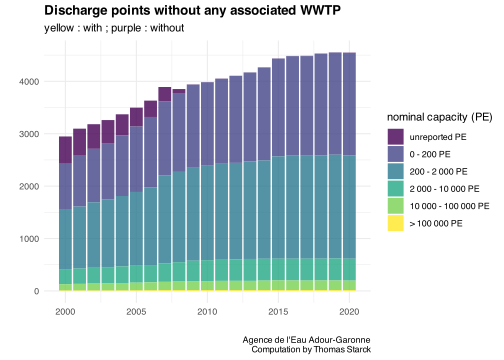
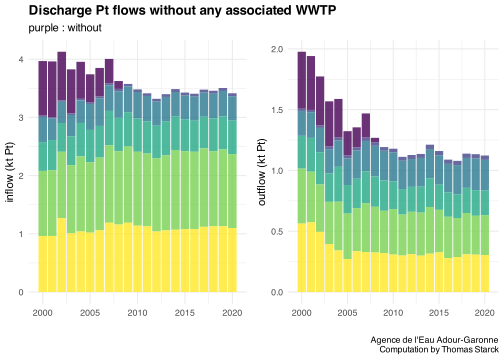
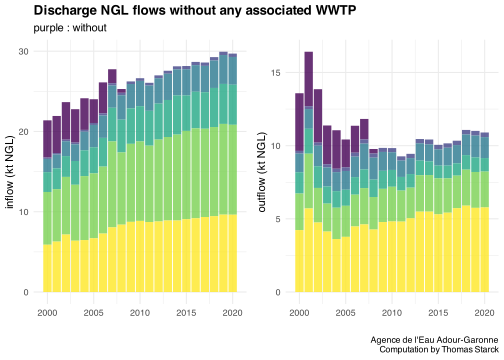
There are some reported discharge points without any associated WWTP, but only before 2008. In terms of flows (here for Pt and NGL) these points are not negligible.

Code
#check if no doublons
doublons <-N_P_adour_garonne %>%
  select(Year, code_discharge) %>%
  count(Year, code_discharge) %>%
  filter(n !=1)
#0 doublons for code discharge: pefect !
rm(doublons)
Code
ggplot(basin_PE_N_P_adour_garonne) + 
  geom_col(aes(Year, nb_WWTP, fill = PE_bin), alpha=.8) +
  labs(
    x="", caption =Source, y="",
    title = "Discharge points without any associated WWTP",
    subtitle = "yellow : with ; purple : without",
    fill = "nominal capacity (PE)"
  )

Code
plot_grid(
  #Pt in
  ggplot(basin_PE_N_P_adour_garonne) + 
    geom_col(aes(Year, Pt_in, fill = PE_bin), alpha=.8) +
    theme(legend.position = "none") +
    labs(
      x="", caption ="\n", y="inflow (kt Pt)",
      title = "Discharge Pt flows without any associated WWTP",
      subtitle = "purple : without"
    ),
  #Pt out
  ggplot(basin_PE_N_P_adour_garonne) + 
    geom_col(aes(Year, Pt_out, fill = PE_bin), alpha=.8) +
    theme(legend.position = "none") +
    labs(
      x="", caption =Source, y="outflow (kt Pt)",
      title = "",
      subtitle = ""
    )
)

Code
plot_grid(
  #NGL in
  ggplot(basin_PE_N_P_adour_garonne) + 
    geom_col(aes(Year, NGL_in, fill = PE_bin), alpha=.8) +
    theme(legend.position = "none") +
    labs(
      x="", caption ="\n", y="inflow (kt NGL)",
      title = "Discharge NGL flows without any associated WWTP",
      subtitle = "purple : without"
    ),
  #NGL out
  ggplot(basin_PE_N_P_adour_garonne) + 
    geom_col(aes(Year, NGL_out, fill = PE_bin), alpha=.8) +
    theme(legend.position = "none") +
    labs(
      x="", caption =Source, y="outflow (kt NGL)",
      title = "",
      subtitle = ""
    )
)

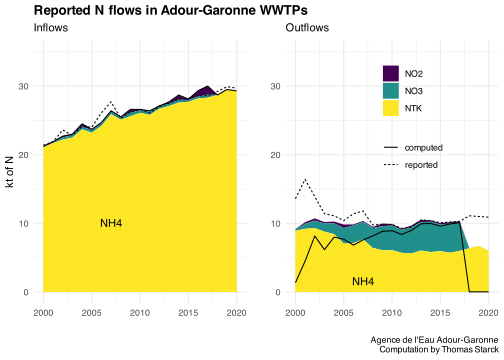
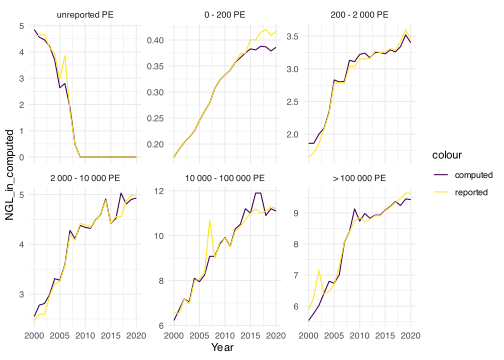
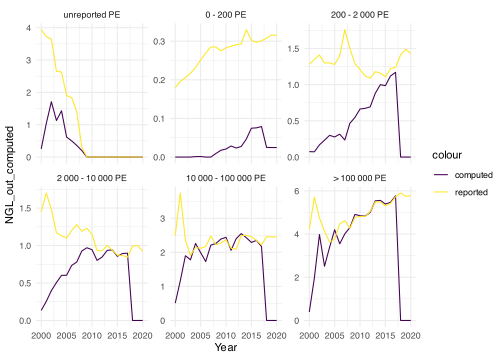
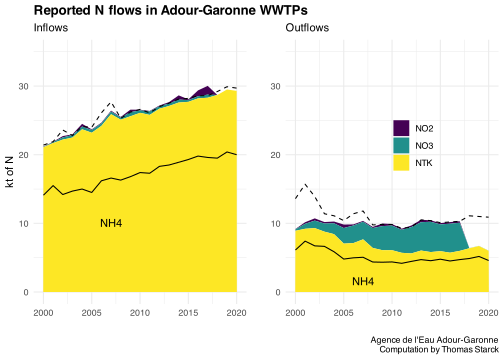
We compare the reported NGL to our computed NGL (from NTK, NO2 and NO3). There is a good match for incoming flows (and for incoming flow NGL ~ NTK). This is not the case for outgoing flow, probably because NO3 is often not reported (which is an exclusion criteria for our computing method); same problem for 2018-2020. The reported NGL quantity seems coherent, so we choose to keep this one over our computed result.

Code
# N in data preparation
temp <- basin_N_P_adour_garonne %>% select(Year, NTK_in, NO2_in, NO3_in) %>%
  gather(key = N_type, value = kt, NTK_in, NO2_in, NO3_in)
# N out preaparation
temp2 <- basin_N_P_adour_garonne %>% 
  #renaming for the legend
  select(Year, NTK=NTK_out, NO2=NO2_out, NO3=NO3_out) %>%
  gather(key = N_type, value = kt, NTK, NO2, NO3)

#graphs
plot_grid(
  ggplot(temp) +
    geom_area(
      aes(
        Year, kt, 
        fill = N_type
        )
      ) +
    geom_line(
      data = basin_N_P_adour_garonne, 
      aes(
        Year, NGL_in_computed, linetype="computed"
        )
      ) +
    geom_line(
      data = basin_N_P_adour_garonne, 
      aes(
        Year, NGL_in, linetype="reported"
        )
      ) +
    theme(legend.position = "none") +
    annotate("text", x=2007, y=10, label="NH4") +
    labs(
      x="", y="kt of N", 
      title = "Reported N flows in Adour-Garonne WWTPs",
      subtitle = "Inflows",
      caption=""
    ) +
    ylim(0, 35),
  ggplot(temp2) +
    geom_area(
      aes(
        Year, kt, 
        fill = N_type
        )
      ) +
    geom_line(
      data = basin_N_P_adour_garonne, 
      aes(
        Year, NGL_out_computed, linetype="computed"
        )
      ) +
    geom_line(
      data = basin_N_P_adour_garonne, 
      aes(
        Year, NGL_out, linetype="reported"
        )
      ) +
    theme(
      legend.position = c(0.6, 0.7), 
      legend.title = element_blank()
      ) +
    annotate(
      "text", label="NH4", 
      x=2007, y=1.5
      ) +
    labs(
      x="", y="", 
      title = "",
      subtitle = "Outflows",
      caption=Source
    ) + 
    ylim(0, 35),
  align = "hv"
)

Code
ggplot(basin_PE_N_P_adour_garonne) +
  geom_line(aes(Year, NGL_in_computed, color="computed")) +
  geom_line(aes(Year, NGL_in, color="reported")) +
  facet_wrap(vars(PE_bin), scales="free_y")

Code
ggplot(basin_PE_N_P_adour_garonne) +
  geom_line(aes(Year, NGL_out_computed, color="computed")) +
  geom_line(aes(Year, NGL_out, color="reported")) +
  facet_wrap(vars(PE_bin), scales="free_y")

Data Cleaning

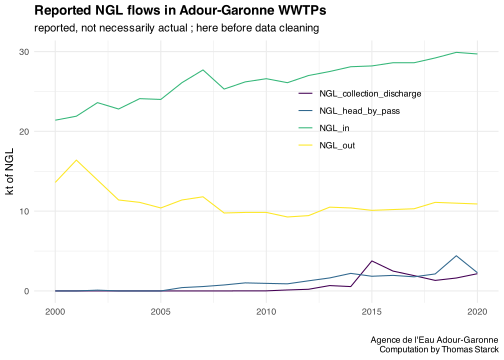
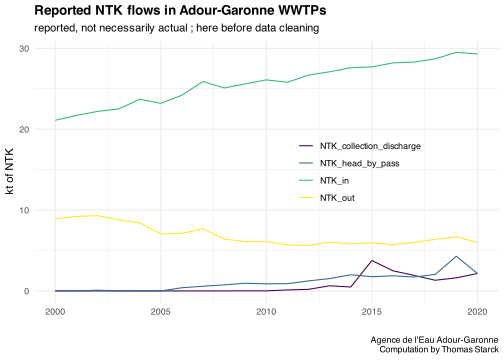
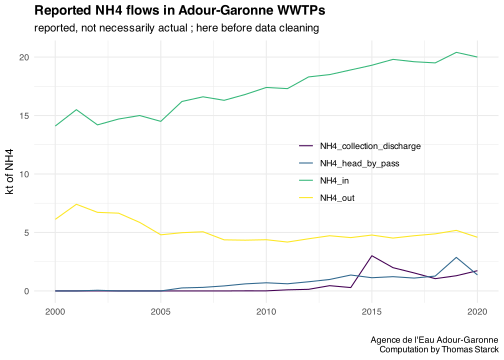
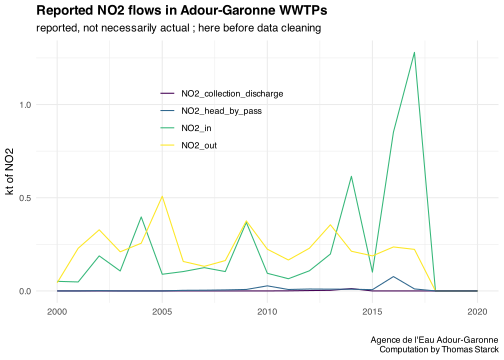
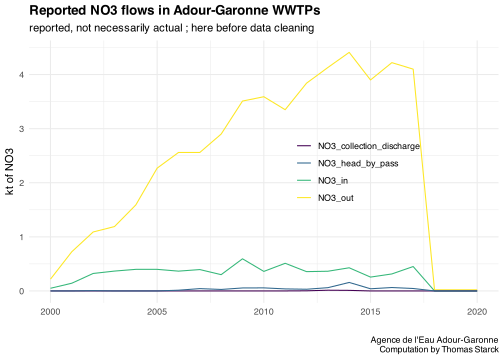
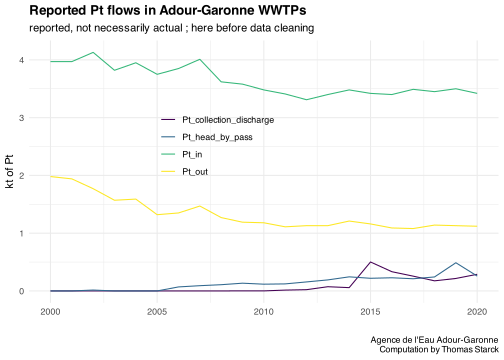
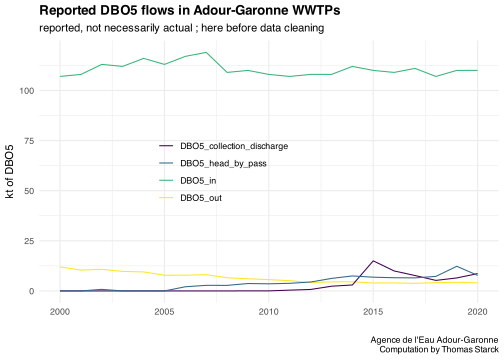
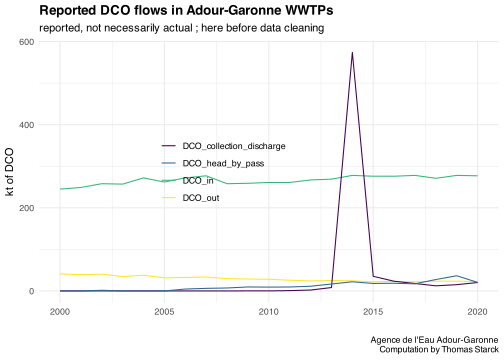
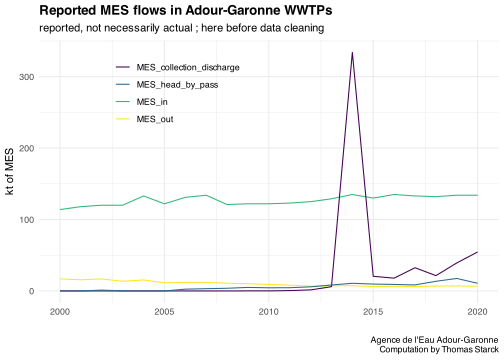
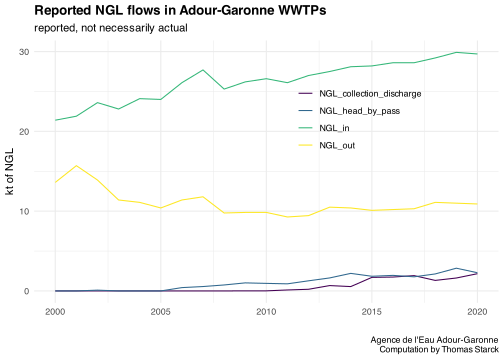
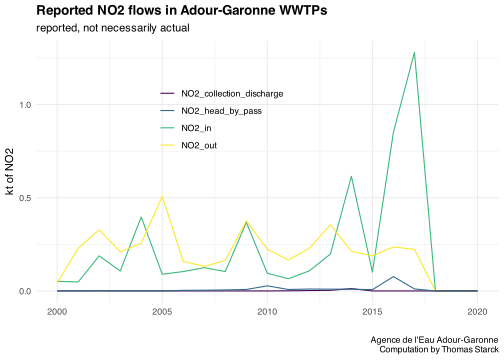
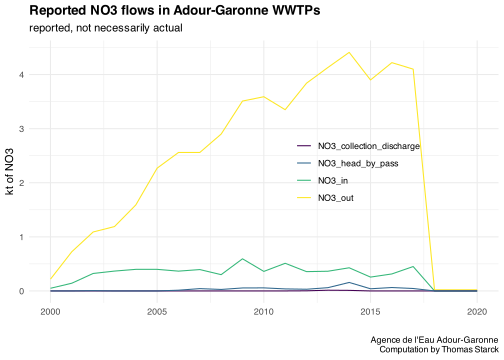
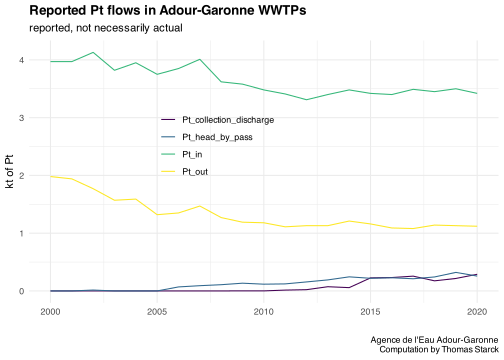
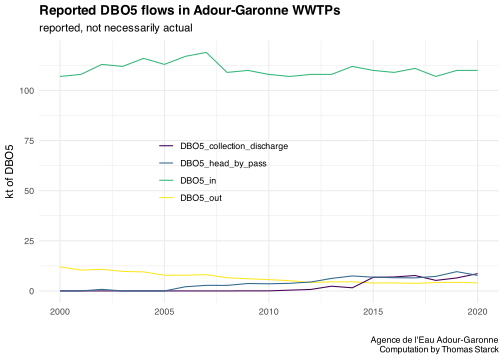
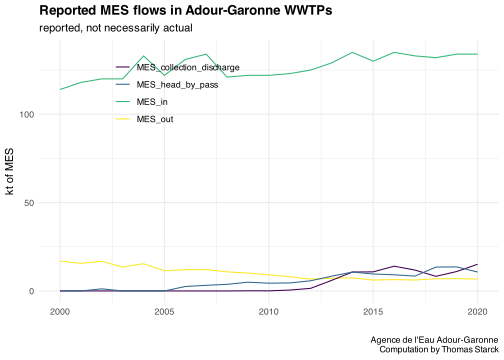
For all nutrients, inflow an outflows seem consistent, except for NO2 (very small quantities with high volatility). There are some obvious errors for all nutrients regarding head by pass and collection discharge. We correct them in the “outliers correction” tab.

Code
f_graph_nutrient <- 
  function (
    dataset, 
    nutrient_in, nutrient_out, nutrient_head_by_pass, nutrient_collection_discharge,
    label, legend_x, legend_y
    ) {
    p <- ggplot(dataset) + 
      #nutrient inflow
      geom_line(
        aes(
          Year, 
          !!as.symbol(nutrient_in), 
          color=nutrient_in
          )
        ) + 
      #nutrient outflow
      geom_line(
        aes(
          Year,
          !!as.symbol(nutrient_out), 
          color = nutrient_out
          )
        ) +
      #nutrient discharge
      geom_line(
        aes(
          Year,
          !!as.symbol(nutrient_collection_discharge), 
          color = nutrient_collection_discharge
          )
        ) +
      #nutrient by pass
      geom_line(
        aes(
          Year,
          !!as.symbol(nutrient_head_by_pass), 
          color = nutrient_head_by_pass
          )
        ) +
      ylim(0, NA) +
      theme(
        legend.position = c(legend_x, legend_y), 
        legend.title = element_blank()
        ) +
      labs(
        x="", y=paste("kt of", label) , 
        title = paste("Reported", label, "flows in Adour-Garonne WWTPs") ,
        subtitle = "reported, not necessarily actual ; here before data cleaning", 
        caption = Source
        )
  return(p)
}
Code
f_graph_nutrient(
  basin_N_P_adour_garonne, 
  "NGL_in", "NGL_out", "NGL_head_by_pass", "NGL_collection_discharge",
  "NGL", 0.7, 0.7) 

Code
f_graph_nutrient(
  basin_N_P_adour_garonne, 
  "NTK_in", "NTK_out", "NTK_head_by_pass", "NTK_collection_discharge",
  "NTK", 0.7, 0.5) 

Code
f_graph_nutrient(
  basin_N_P_adour_garonne, 
  "NH4_in", "NH4_out", "NH4_head_by_pass", "NH4_collection_discharge",
  "NH4", 0.7, 0.5) 

Code
f_graph_nutrient(
  basin_N_P_adour_garonne, 
  "NO2_in", "NO2_out", "NO2_head_by_pass", "NO2_collection_discharge",
  "NO2", 0.4, 0.7) 

Code
f_graph_nutrient(
  basin_N_P_adour_garonne, 
  "NO3_in", "NO3_out", "NO3_head_by_pass", "NO3_collection_discharge",
  "NO3", 0.7, 0.5) 

Code
f_graph_nutrient(
  basin_N_P_adour_garonne, 
  "Pt_in", "Pt_out", "Pt_head_by_pass", "Pt_collection_discharge",
  "Pt", 0.4, 0.6) 

Code
f_graph_nutrient(
  basin_N_P_adour_garonne, 
  "DBO5_in", "DBO5_out", "DBO5_head_by_pass", "DBO5_collection_discharge",
  "DBO5", 0.4, 0.5)  

Code
f_graph_nutrient(
  basin_N_P_adour_garonne, 
  "DCO_in", "DCO_out", "DCO_head_by_pass", "DCO_collection_discharge",
  "DCO", 0.4, 0.5)  

Code
f_graph_nutrient(
  basin_N_P_adour_garonne, 
  "MES_in", "MES_out", "MES_head_by_pass", "MES_collection_discharge",
  "MES", 0.3, 0.8)

For all nutrient collection discharge for 0512084V0011 (CREISSELS (MILLAU)), in 2016 divide flow by 10, remove 2015 (inconsistent)

Code
# code_rj 0512084V0011 (CREISSELS (MILLAU)) : factor 10 for all discharge in 2016
#DBO5
N_P_adour_garonne$DBO5_collection_discharge[N_P_adour_garonne$code_discharge == "0512084V0011" & N_P_adour_garonne$Year == 2016] <- 
  N_P_adour_garonne$DBO5_collection_discharge[N_P_adour_garonne$code_discharge == "0512084V0011" & N_P_adour_garonne$Year == 2016]/10
#DCO
N_P_adour_garonne$DCO_collection_discharge[N_P_adour_garonne$code_discharge == "0512084V0011" & N_P_adour_garonne$Year == 2016] <- 
  N_P_adour_garonne$DCO_collection_discharge[N_P_adour_garonne$code_discharge == "0512084V0011" & N_P_adour_garonne$Year == 2016]/10
#MES
N_P_adour_garonne$MES_collection_discharge[N_P_adour_garonne$code_discharge == "0512084V0011" & N_P_adour_garonne$Year == 2016] <- 
  N_P_adour_garonne$MES_collection_discharge[N_P_adour_garonne$code_discharge == "0512084V0011" & N_P_adour_garonne$Year == 2016]/10
#NGL
N_P_adour_garonne$NGL_collection_discharge[N_P_adour_garonne$code_discharge == "0512084V0011" & N_P_adour_garonne$Year == 2016] <- 
  N_P_adour_garonne$NGL_collection_discharge[N_P_adour_garonne$code_discharge == "0512084V0011" & N_P_adour_garonne$Year == 2016]/10
#NH4
N_P_adour_garonne$NH4_collection_discharge[N_P_adour_garonne$code_discharge == "0512084V0011" & N_P_adour_garonne$Year == 2016] <- 
  N_P_adour_garonne$NH4_collection_discharge[N_P_adour_garonne$code_discharge == "0512084V0011" & N_P_adour_garonne$Year == 2016]/10
#NO2 and NO3 not reported
#NTK
N_P_adour_garonne$NTK_collection_discharge[N_P_adour_garonne$code_discharge == "0512084V0011" & N_P_adour_garonne$Year == 2016] <- 
  N_P_adour_garonne$NTK_collection_discharge[N_P_adour_garonne$code_discharge == "0512084V0011" & N_P_adour_garonne$Year == 2016]/10
#Pt
N_P_adour_garonne$Pt_collection_discharge[N_P_adour_garonne$code_discharge == "0512084V0011" & N_P_adour_garonne$Year == 2016] <- 
  N_P_adour_garonne$Pt_collection_discharge[N_P_adour_garonne$code_discharge == "0512084V0011" & N_P_adour_garonne$Year == 2016]/10
#volume
N_P_adour_garonne$VOL_collection_discharge[N_P_adour_garonne$code_discharge == "0512084V0011" & N_P_adour_garonne$Year == 2016] <- 
  N_P_adour_garonne$VOL_collection_discharge[N_P_adour_garonne$code_discharge == "0512084V0011" & N_P_adour_garonne$Year == 2016]/10

# code_discharge 0512084V0011 (CREISSELS (MILLAU)) : NA for all discharge in 2015
#DBO5
N_P_adour_garonne$DBO5_collection_discharge[N_P_adour_garonne$code_discharge == "0512084V0011" & N_P_adour_garonne$Year == 2015] <- NA
#DCO
N_P_adour_garonne$DCO_collection_discharge[N_P_adour_garonne$code_discharge == "0512084V0011" & N_P_adour_garonne$Year == 2015] <- NA
#MES
N_P_adour_garonne$MES_collection_discharge[N_P_adour_garonne$code_discharge == "0512084V0011" & N_P_adour_garonne$Year == 2015] <- NA
#NGL
N_P_adour_garonne$NGL_collection_discharge[N_P_adour_garonne$code_discharge == "0512084V0011" & N_P_adour_garonne$Year == 2015] <- NA
#NH4
N_P_adour_garonne$NH4_collection_discharge[N_P_adour_garonne$code_discharge == "0512084V0011" & N_P_adour_garonne$Year == 2015] <- NA
#NO2 and NO3 not reported
#NTK
N_P_adour_garonne$NTK_collection_discharge[N_P_adour_garonne$code_discharge == "0512084V0011" & N_P_adour_garonne$Year == 2015] <- NA
#Pt
N_P_adour_garonne$Pt_collection_discharge[N_P_adour_garonne$code_discharge == "0512084V0011" & N_P_adour_garonne$Year == 2015] <- NA
#volume
N_P_adour_garonne$VOL_collection_discharge[N_P_adour_garonne$code_discharge == "0512084V0011" & N_P_adour_garonne$Year == 2015] <- NA

2019 head by pass : 0519255V0021 SEILHAC (BOURG) factor 1000 for all nutrients

Code
# code_rj 0512084V0011 (CREISSELS (MILLAU)) : factor 10 for all discharge in 2016
#DBO5
N_P_adour_garonne$DBO5_head_by_pass[N_P_adour_garonne$code_discharge == "0519255V0021" & N_P_adour_garonne$Year == 2019] <- 
  N_P_adour_garonne$DBO5_head_by_pass[N_P_adour_garonne$code_discharge == "0519255V0021" & N_P_adour_garonne$Year == 2019]/1000
#DCO
N_P_adour_garonne$DCO_head_by_pass[N_P_adour_garonne$code_discharge == "0519255V0021" & N_P_adour_garonne$Year == 2019] <- 
  N_P_adour_garonne$DCO_head_by_pass[N_P_adour_garonne$code_discharge == "0519255V0021" & N_P_adour_garonne$Year == 2019]/1000
#MES
N_P_adour_garonne$MES_head_by_pass[N_P_adour_garonne$code_discharge == "0519255V0021" & N_P_adour_garonne$Year == 2019] <- 
  N_P_adour_garonne$MES_head_by_pass[N_P_adour_garonne$code_discharge == "0519255V0021" & N_P_adour_garonne$Year == 2019]/1000
#NGL
N_P_adour_garonne$NGL_head_by_pass[N_P_adour_garonne$code_discharge == "0519255V0021" & N_P_adour_garonne$Year == 2019] <- 
  N_P_adour_garonne$NGL_head_by_pass[N_P_adour_garonne$code_discharge == "0519255V0021" & N_P_adour_garonne$Year == 2019]/1000
#NH4
N_P_adour_garonne$NH4_head_by_pass[N_P_adour_garonne$code_discharge == "0519255V0021" & N_P_adour_garonne$Year == 2019] <- 
  N_P_adour_garonne$NH4_head_by_pass[N_P_adour_garonne$code_discharge == "0519255V0021" & N_P_adour_garonne$Year == 2019]/1000
#NO2 and NO3 not reported
#NTK
N_P_adour_garonne$NTK_head_by_pass[N_P_adour_garonne$code_discharge == "0519255V0021" & N_P_adour_garonne$Year == 2019] <- 
  N_P_adour_garonne$NTK_head_by_pass[N_P_adour_garonne$code_discharge == "0519255V0021" & N_P_adour_garonne$Year == 2019]/1000
#Pt
N_P_adour_garonne$Pt_head_by_pass[N_P_adour_garonne$code_discharge == "0519255V0021" & N_P_adour_garonne$Year == 2019] <- 
  N_P_adour_garonne$Pt_head_by_pass[N_P_adour_garonne$code_discharge == "0519255V0021" & N_P_adour_garonne$Year == 2019]/1000
#volume
N_P_adour_garonne$VOL_head_by_pass[N_P_adour_garonne$code_discharge == "0519255V0021" & N_P_adour_garonne$Year == 2019] <- 
  N_P_adour_garonne$VOL_head_by_pass[N_P_adour_garonne$code_discharge == "0519255V0021" & N_P_adour_garonne$Year == 2019]/1000

Collection discharge have a big outlier in 2014, for 0564545V0051 (INTERCOMMUNALE URRUGNE) : DBO5 factor 10, DCO factor 1000, MES factor 1000

Code
#MES
N_P_adour_garonne$MES_collection_discharge[N_P_adour_garonne$code_discharge == "0564545V0051" & N_P_adour_garonne$Year == 2014] <- 
  N_P_adour_garonne$MES_collection_discharge[N_P_adour_garonne$code_discharge == "0564545V0051" & N_P_adour_garonne$Year == 2014]/1000
#DCO
N_P_adour_garonne$DCO_collection_discharge[N_P_adour_garonne$code_discharge == "0564545V0051" & N_P_adour_garonne$Year == 2014] <- 
  N_P_adour_garonne$DCO_collection_discharge[N_P_adour_garonne$code_discharge == "0564545V0051" & N_P_adour_garonne$Year == 2014]/1000
#DBO5
N_P_adour_garonne$DBO5_collection_discharge[N_P_adour_garonne$code_discharge == "0564545V0051" & N_P_adour_garonne$Year == 2014] <- 
  N_P_adour_garonne$DBO5_collection_discharge[N_P_adour_garonne$code_discharge == "0564545V0051" & N_P_adour_garonne$Year == 2014]/10

MES collection discharge starting 2016, very high values for 0540192V0031, inconsistent, we remove them all. For 0524037V0031, factor 1000 in 2017

Code
#MES
N_P_adour_garonne$MES_collection_discharge[N_P_adour_garonne$code_discharge == "0540192V0031" & N_P_adour_garonne$Year %in% c(2016, 2017, 2018, 2019, 2020)] <- NA

N_P_adour_garonne$MES_collection_discharge[N_P_adour_garonne$code_discharge == "0524037V0031" & N_P_adour_garonne$Year ==2017] <-
  N_P_adour_garonne$MES_collection_discharge[N_P_adour_garonne$code_discharge == "0524037V0031" & N_P_adour_garonne$Year ==2017]/1000

All for 0519272V0041 in 2008 negative values head by pass => NA

Code
#DBO5
N_P_adour_garonne$DBO5_collection_discharge[N_P_adour_garonne$code_discharge == "0519272V0041" & N_P_adour_garonne$Year == 2008] <- NA
#DCO
N_P_adour_garonne$DCO_collection_discharge[N_P_adour_garonne$code_discharge == "0519272V0041" & N_P_adour_garonne$Year == 2008] <- NA
#MES
N_P_adour_garonne$MES_collection_discharge[N_P_adour_garonne$code_discharge == "0519272V0041" & N_P_adour_garonne$Year == 2008] <- NA
#NGL
N_P_adour_garonne$NGL_collection_discharge[N_P_adour_garonne$code_discharge == "0519272V0041" & N_P_adour_garonne$Year == 2008] <- NA
#NH4
N_P_adour_garonne$NH4_collection_discharge[N_P_adour_garonne$code_discharge == "0519272V0041" & N_P_adour_garonne$Year == 2008] <- NA
#NO2
N_P_adour_garonne$NO2_collection_discharge[N_P_adour_garonne$code_discharge == "0519272V0041" & N_P_adour_garonne$Year == 2008] <- NA
#NO3
N_P_adour_garonne$NO3_collection_discharge[N_P_adour_garonne$code_discharge == "0519272V0041" & N_P_adour_garonne$Year == 2008] <- NA
#NTK
N_P_adour_garonne$NTK_collection_discharge[N_P_adour_garonne$code_discharge == "0519272V0041" & N_P_adour_garonne$Year == 2008] <- NA
#Pt
N_P_adour_garonne$Pt_collection_discharge[N_P_adour_garonne$code_discharge == "0519272V0041" & N_P_adour_garonne$Year == 2008] <- NA
#volume
N_P_adour_garonne$VOL_collection_discharge[N_P_adour_garonne$code_discharge == "0519272V0041" & N_P_adour_garonne$Year == 2008] <- NA

for NLG out in 2001 for code_discharge 0531555V0181, just reported same value as NGL_in. We change this by a typical value considering the adjacent years.

Code
#DBO5
N_P_adour_garonne$NGL_out[N_P_adour_garonne$code_discharge == "0531555V0181" & N_P_adour_garonne$Year == 2001] <- 4500

We recompute the values (yields, ratios, aggregate at the basin scale…) after our outliers changes. We save the final data.

Code
N_P_adour_garonne <- N_P_adour_garonne %>%
  mutate(
    #Computes yields 
    Pt_yield = (1-Pt_out/Pt_in)*100, 
    NGL_yield = (1-NGL_out/NGL_in)*100,
    DBO5_yield =(1-DBO5_out/DBO5_in)*100, 
    DCO_yield =(1-DCO_out/DCO_in)*100,
    MES_yield =(1-MES_out/MES_in)*100,
    #nutrient ratios
    N_P_ratio_in = NGL_in/Pt_in, 
    N_P_ratio_out = NGL_out/Pt_out,
    DCO_DBO5_ratio_in = DCO_in/DBO5_in,
    DCO_DBO5_ratio_out = DCO_out/DBO5_out,
    DBO5_N_ratio_in = DBO5_in/NGL_in,
    DBO5_N_ratio_out = DBO5_out/NGL_out,
    DBO5_Pt_ratio_in = DBO5_in/Pt_in,
    DBO5_Pt_ratio_out = DBO5_out/Pt_out
  )
Code
#recompute basin values (flows, yields, ratios..)
basin_N_P_adour_garonne <- f_basin_flows(N_P_adour_garonne)
basin_N_P_adour_garonne <- f_all_nutrient_ratios_basin(basin_N_P_adour_garonne, N_P_adour_garonne)
basin_N_P_adour_garonne <- f_all_yields_basin(basin_N_P_adour_garonne, N_P_adour_garonne)
basin_N_P_adour_garonne <- f_year_categories(basin_N_P_adour_garonne)

#recompute basin x PE values (flows, yields, ratios..)
basin_PE_N_P_adour_garonne <- f_basin_PE_flows(N_P_adour_garonne)
basin_PE_N_P_adour_garonne <- f_all_nutrient_ratios_basin_PE(basin_PE_N_P_adour_garonne, N_P_adour_garonne)
basin_PE_N_P_adour_garonne <- f_all_yields_basin_PE(basin_PE_N_P_adour_garonne, N_P_adour_garonne)
basin_PE_N_P_adour_garonne <- f_year_categories(basin_PE_N_P_adour_garonne)

Capacities distribution

Code
temp <- N_P_adour_garonne %>%
  group_by(Year) %>%
  summarise(
    capacity = sum(capacity, na.rm = T)/10^6, #capacity in million PE
    nb_WWTP = n()
  )

n_min <- first(temp$nb_WWTP)
n_max <- last(temp$nb_WWTP)
capacity_min <- round(first(temp$capacity), digits=1)
capacity_max <- round(last(temp$capacity), digits=1)

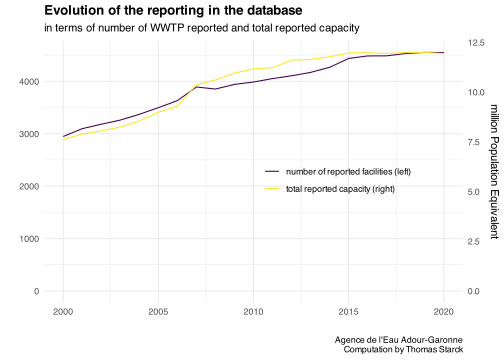
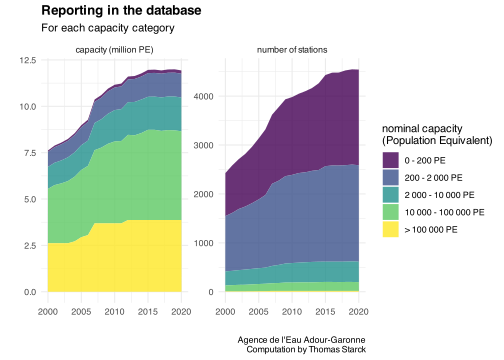
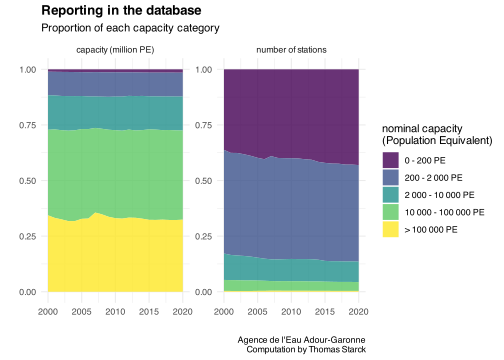
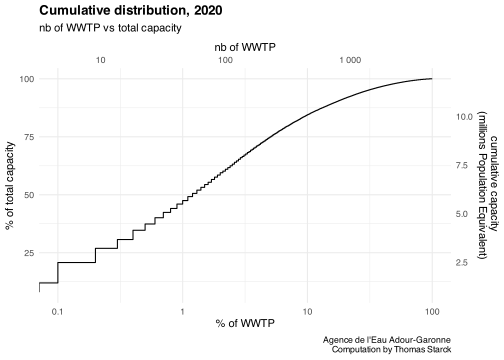
The number of listed plants in the data base increases from 2948 to 4549 (a 54% increase) between 2000 and 2020, and the total capacity increases by 57% from 7.6 to 11.9 million Population Equivalent.

The total reported capacity stabilizes around 2015.

Code
coef <- max(temp$capacity)/max(temp$nb_WWTP)
ggplot(temp) +
  geom_line(
    aes(
      Year, nb_WWTP, 
      color = "number of reported facilities (left)"
      )
    ) + 
  geom_line(
    aes(
      Year, capacity/coef, 
      color = "total reported capacity (right)"
      )
    ) + 
  scale_y_continuous(
    limits = c(0, NA),
    sec.axis = 
      sec_axis(
        trans=~.*coef, 
        name="million Population Equivalent"
        )
    ) +
  labs(
    title = "Evolution of the reporting in the database",
    subtitle = "in terms of number of WWTP reported and total reported capacity",
    y="", x="", 
    color="", caption =Source
  ) +
  theme(
    legend.position = c(0.7, 0.5)
  )

Code
temp <- N_P_adour_garonne %>%
  filter(is.na(capacity)==F) %>%
  select(Year, capacity, PE_bin) %>%
  group_by(Year, PE_bin) %>%
  summarise(
    `capacity (million PE)` = sum(capacity)/10^6,
    `number of stations` = n()
  ) %>% 
  gather(key=capacity_or_n, value = value, `capacity (million PE)`, `number of stations`)
Code
ggplot(temp) + 
  geom_area(aes(Year, value, fill=PE_bin), alpha=.8) + 
  facet_wrap(vars(capacity_or_n), scales="free") + 
  scale_fill_viridis(discrete = T) +
  labs(
    title="Reporting in the database",
    subtitle = "For each capacity category",
    x="", y="", fill="nominal capacity \n(Population Equivalent)",
    caption = Source
  )

Code
ggplot(temp) + 
  geom_area(aes(Year, value, fill=PE_bin), position = "fill", alpha=.8) + 
  facet_wrap(vars(capacity_or_n), scales="free") + 
  scale_fill_viridis(discrete = T) +
  labs(
    title="Reporting in the database",
    subtitle = "Proportion of each capacity category",
    x="", y="", fill="nominal capacity \n(Population Equivalent)",
    caption = Source
  )

Code
temp <- N_P_adour_garonne %>% filter(Year==Year_analysis)
ggplot(temp) + 
  geom_histogram(
    aes(
      capacity, 
      fill = "Nb of facilities"
      ), 
    n=100, alpha=.4, stat="density"
    ) +
  geom_histogram(
    aes(
      capacity, weight = capacity, 
      fill="Nb of facilities weighted by capacity"
      ), 
    n=100, alpha=.4, stat="density"
    ) +
  theme(
    legend.position = c(0.7,0.8),
  ) +
  labs(
    x="Waste Water Treatment Plant Capacity \n(Population Equivalent)",
    y="Distribution density",
    fill="Distribution of",
    title = paste("WWTP capacities distribution,", as.character(Year_analysis)),
    subtitle = "raw or weighted by capacity"
  ) +
  scale_x_log10(
    labels = scales::label_number(drop0trailing = TRUE)
    )

Code
temp <- N_P_adour_garonne %>% 
  ungroup() %>%
  filter(Year==Year_analysis) %>% 
  select(code_WWTP, name_WWTP, capacity) %>%
  filter(is.na(capacity) == F) %>%
  arrange(desc(capacity)) %>%
  mutate( 
    cumulative_capacity = cumsum(capacity)/10^6,
    rank_STEU = rank(-capacity, ties.method = "first"),
    percent_cumulative_capacity = round(cumulative_capacity/sum(capacity/10^6)*100, digits = 1),
    percent_rank = round(rank_STEU/n()*100, digits = 1)
    ) 

f_save_csv_files(
  temp %>% mutate(basin = "Adour-Garonne"), 
  "output_data/zipf_law/",
  "zipf_law_05_adour_garonne.csv"
)

coef <- max(temp$rank_STEU)/100
coef2 <- max(temp$cumulative_capacity)/100
Code
ggplot(temp) +
  geom_step(
    aes(
      x = percent_rank, y = percent_cumulative_capacity
      )
    ) + 
  labs(
    title = paste("Cumulative distribution,", Year_analysis),
    subtitle="nb of WWTP vs total capacity",
    x="% of WWTP", y="% of total capacity",
    caption = Source
  ) +
  scale_x_continuous(
    sec.axis = 
      sec_axis(
        trans=~.*coef, name="nb of WWTP",
        labels = scales::label_number(drop0trailing = TRUE)
        )
    ) + 
  scale_y_continuous(
    sec.axis = 
      sec_axis(
        trans=~.*coef2, 
        name="cumulative capacity \n(millions PE)"
        )
    ) + 
    theme(legend.position = "none")

Code
ggplot(temp) +
  geom_step(
    aes(
      x = percent_rank, y = percent_cumulative_capacity
      )
    ) + 
  labs(
    title = paste("Cumulative distribution,", Year_analysis),
    subtitle="nb of WWTP vs total capacity",
    x="% of WWTP", y="% of total capacity",
    caption = Source
  ) +
  scale_x_log10(
    labels = scales::label_number(drop0trailing = TRUE),
    sec.axis = 
      sec_axis(
        trans=~.*coef, 
        name="nb of WWTP",
        labels = scales::label_number(drop0trailing = TRUE)
        )
    ) + 
  scale_y_continuous(
    sec.axis = 
      sec_axis(
        trans=~.*coef2, 
        name="cumulative capacity \n(millions Population Equivalent)"
        )
    ) + 
    theme(legend.position = "none")

Code
ggplot(temp) +
  geom_point(
    aes(
      x = rank_STEU, y = capacity
      )
    ) + 
  labs(
    title = paste("WWTP capacity vs rank,", Year_analysis),
    subtitle = "looking for a Zipf law",
    x="Waste Water Treatment Plant \n(ranked by capacity)",
    y=" Waste Water Treatment Plant capacity\n(Population Equivalent)"
    ) +
  scale_x_log10(
    labels = scales::label_number(drop0trailing = TRUE)
    ) + 
  scale_y_log10(
    labels = scales::label_number(drop0trailing = TRUE)
    )

Pollution flows

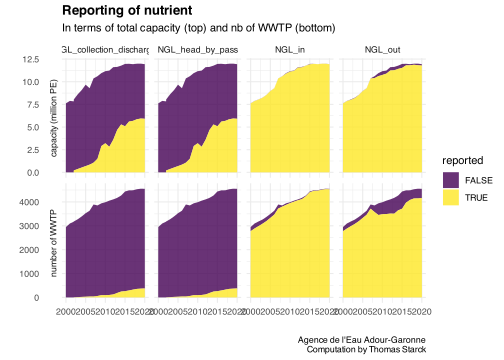
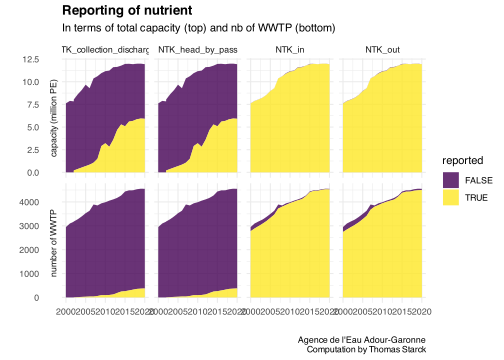
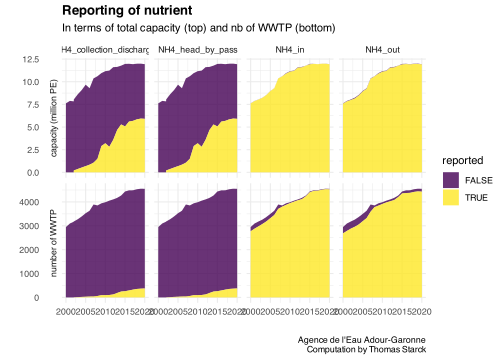
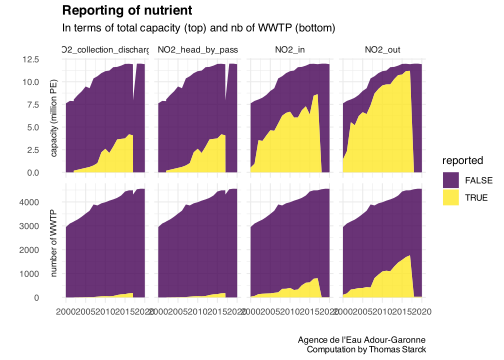
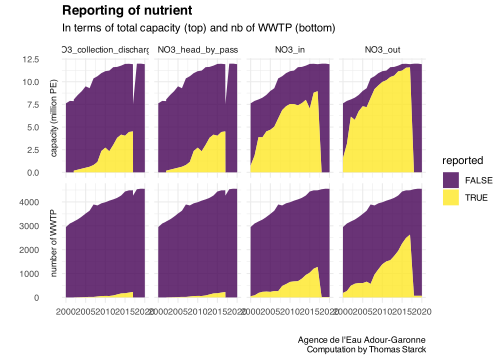
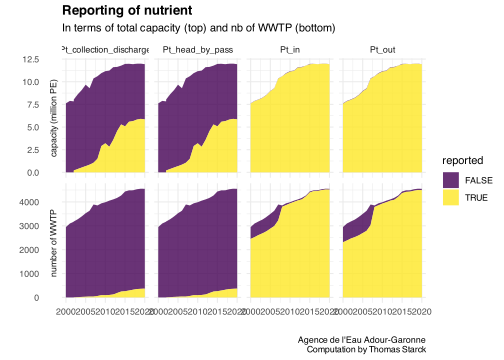
Navigate through tabs below to see details for each pollutant. For each pollutant, we present reporting for incoming and outgoing pollution, in terms of number of WWTP reporting the data or in terms of installed capacity.

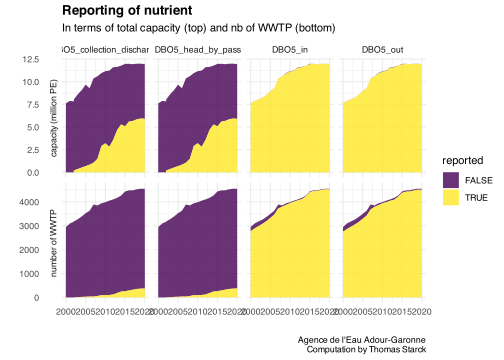
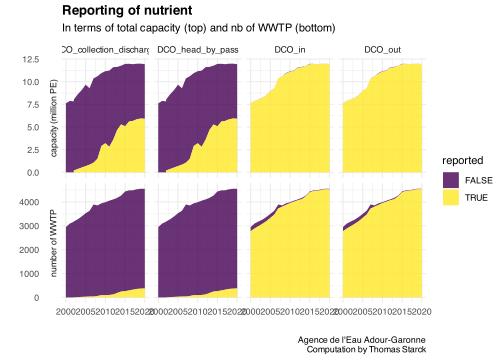
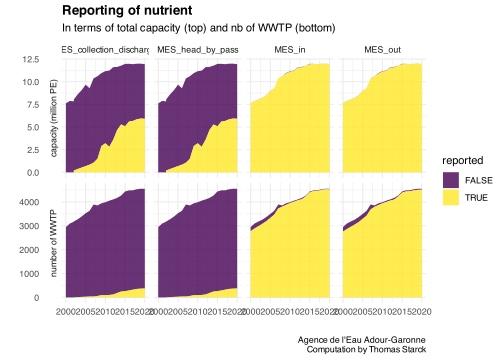
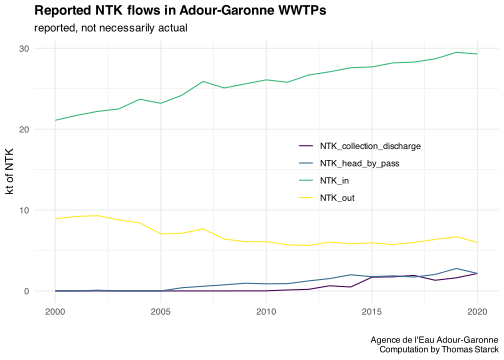
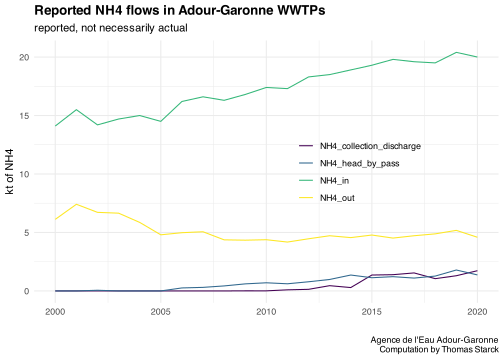
NTK, NH4, Pt, DBO5, DCO and MES are extremely well reported for both in and out flows. NGL in is also very well reported, but this is less the case for NGL out with 15% of WWTP not reporting it in 2010, and less after. However in terms of capacity it represents less than 4%.

NO2 and NO3 are poorly reported

Code
f_graph_reporting_nutrients <- function(pollution_in, pollution_out, pollution_DO, pollution_BP){
  temp <- N_P_adour_garonne %>%
    select(
      Year, capacity, 
      !!as.symbol(pollution_in), !!as.symbol(pollution_out),
      !!as.symbol(pollution_DO), !!as.symbol(pollution_BP)
      ) %>%
    mutate(
      nutrient_in = is.na(!!as.symbol(pollution_in))==F,
      nutrient_out = is.na(!!as.symbol(pollution_out))==F,
      nutrient_DO = is.na(!!as.symbol(pollution_DO))==F,
      nutrient_BP = is.na(!!as.symbol(pollution_DO))==F
      ) %>%
    gather(
      key=in_out_flow, 
      value = `reported pollution`, 
      nutrient_in, nutrient_out, nutrient_DO, nutrient_BP
      ) %>%
    group_by(
      Year, in_out_flow, `reported pollution`
      ) %>%
    summarise(
      `number of WWTP`=n(), 
      `capacity (million PE)` = sum(capacity, na.rm=T)/10^6
      ) %>%
    gather(
      key=n_or_capacity, 
      value = value, 
      `number of WWTP`, `capacity (million PE)`
      ) %>%
    #renaming labels
    mutate(
      in_out_flow = case_when(
        in_out_flow == "nutrient_in" ~ pollution_in,
        in_out_flow == "nutrient_out" ~ pollution_out,
        in_out_flow == "nutrient_DO" ~ pollution_DO,
        in_out_flow == "nutrient_BP" ~ pollution_BP
      )
    )

  g <- ggplot(temp) +
    geom_area(aes(Year, value, fill=`reported pollution`), alpha=.8) +
    facet_grid(
      n_or_capacity~in_out_flow, 
      scales="free_y", switch = "y") +
    labs(
      y="", x="",
      title = "Reporting of nutrient",
      subtitle = "In terms of total capacity (top) and nb of WWTP (bottom)",
      caption = Source,
      fill="reported"
      ) 

  return(g)
}
Code
f_graph_reporting_nutrients("NGL_in", "NGL_out", "NGL_head_by_pass", "NGL_collection_discharge")

Code
f_graph_reporting_nutrients("NTK_in", "NTK_out", "NTK_head_by_pass", "NTK_collection_discharge")

Code
f_graph_reporting_nutrients("NH4_in", "NH4_out", "NH4_head_by_pass", "NH4_collection_discharge")

Code
f_graph_reporting_nutrients("NO2_in", "NO2_out", "NO2_head_by_pass", "NO2_collection_discharge")

Code
f_graph_reporting_nutrients("NO3_in", "NO3_out", "NO3_head_by_pass", "NO3_collection_discharge")

Code
f_graph_reporting_nutrients("Pt_in", "Pt_out", "Pt_head_by_pass", "Pt_collection_discharge")

Code
f_graph_reporting_nutrients("DBO5_in", "DBO5_out", "DBO5_head_by_pass", "DBO5_collection_discharge")

Code
f_graph_reporting_nutrients("DCO_in", "DCO_out", "DCO_head_by_pass", "DCO_collection_discharge")

Code
f_graph_reporting_nutrients("MES_in", "MES_out", "MES_head_by_pass", "MES_collection_discharge")

Code
f_graph_nutrient <- 
  function (
    dataset, 
    nutrient_in, nutrient_out, nutrient_head_by_pass, nutrient_collection_discharge,
    label, legend_x, legend_y
    ) {
    p <- ggplot(dataset) + 
      #nutrient inflow
      geom_line(
        aes(
          Year, 
          !!as.symbol(nutrient_in), 
          color=nutrient_in
          )
        ) + 
      #nutrient outflow
      geom_line(
        aes(
          Year,
          !!as.symbol(nutrient_out), 
          color = nutrient_out
          )
        ) +
      #nutrient discharge
      geom_line(
        aes(
          Year,
          !!as.symbol(nutrient_collection_discharge), 
          color = nutrient_collection_discharge
          )
        ) +
      #nutrient by pass
      geom_line(
        aes(
          Year,
          !!as.symbol(nutrient_head_by_pass), 
          color = nutrient_head_by_pass
          )
        ) +
      ylim(0, NA) +
      theme(
        legend.position = c(legend_x, legend_y), 
        legend.title = element_blank()
        ) +
      labs(
        x="", y=paste("kt of", label) , 
        title = paste("Reported", label, "flows in Adour-Garonne WWTPs") ,
        subtitle = "reported, not necessarily actual", 
        caption = Source
        )
  return(p)
}
Code
f_graph_nutrient(
  basin_N_P_adour_garonne, 
  "NGL_in", "NGL_out", "NGL_head_by_pass", "NGL_collection_discharge",
  "NGL", 0.7, 0.7)

Code
f_graph_nutrient(
  basin_N_P_adour_garonne, 
  "NTK_in", "NTK_out", "NTK_head_by_pass", "NTK_collection_discharge",
  "NTK", 0.7, 0.5) 

Code
f_graph_nutrient(
  basin_N_P_adour_garonne, 
  "NH4_in", "NH4_out", "NH4_head_by_pass", "NH4_collection_discharge",
  "NH4", 0.7, 0.5) 

Code
f_graph_nutrient(
  basin_N_P_adour_garonne, 
  "NO2_in", "NO2_out", "NO2_head_by_pass", "NO2_collection_discharge",
  "NO2", 0.4, 0.7) 

Code
f_graph_nutrient(
  basin_N_P_adour_garonne, 
  "NO3_in", "NO3_out", "NO3_head_by_pass", "NO3_collection_discharge",
  "NO3", 0.7, 0.5) 

Code
f_graph_nutrient(
  basin_N_P_adour_garonne, 
  "Pt_in", "Pt_out", "Pt_head_by_pass", "Pt_collection_discharge",
  "Pt", 0.4, 0.6) 

Code
f_graph_nutrient(
  basin_N_P_adour_garonne, 
  "DBO5_in", "DBO5_out", "DBO5_head_by_pass", "DBO5_collection_discharge",
  "DBO5", 0.4, 0.5)  

Code
f_graph_nutrient(
  basin_N_P_adour_garonne, 
  "DCO_in", "DCO_out", "DCO_head_by_pass", "DCO_collection_discharge",
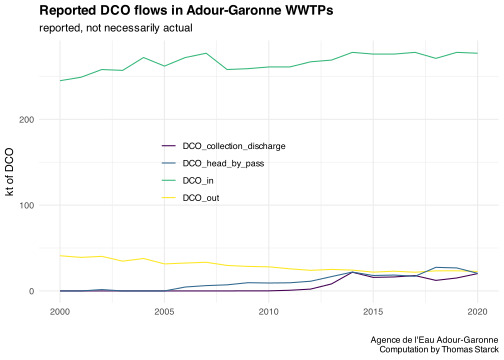
  "DCO", 0.4, 0.5)  

Code
f_graph_nutrient(
  basin_N_P_adour_garonne, 
  "MES_in", "MES_out", "MES_head_by_pass", "MES_collection_discharge",
  "MES", 0.3, 0.8)

Dashed line is NGL to check for constitency.

Code
# N in data preparation
temp <- basin_N_P_adour_garonne %>% select(Year, NTK_in, NO2_in, NO3_in) %>%
  gather(key = N_type, value = kt, NTK_in, NO2_in, NO3_in)
# N out preaparation
temp2 <- basin_N_P_adour_garonne %>% 
  #renaming for the legend
  select(Year, NTK=NTK_out, NO2=NO2_out, NO3=NO3_out) %>%
  gather(key = N_type, value = kt, NTK, NO2, NO3)

#graphs
plot_grid(
  ggplot(temp) +
    geom_area(
      aes(
        Year, kt, 
        fill = N_type
        )
      ) +
    geom_line(
      data = basin_N_P_adour_garonne, 
      aes(
        Year, NH4_in
        )
      ) +
    geom_line(
      data = basin_N_P_adour_garonne, 
      aes(
        Year, NGL_in
        ),
      linetype="dashed"
      ) +
    theme(legend.position = "none") +
    annotate("text", x=2007, y=10, label="NH4") +
    labs(
      x="", y="kt of N", 
      title = "Reported N flows in Adour-Garonne WWTPs",
      subtitle = "Inflows",
      caption=""
    ) +
    ylim(0, 35),
  ggplot(temp2) +
    geom_area(
      aes(
        Year, kt, 
        fill = N_type
        )
      ) +
    geom_line(
      data = basin_N_P_adour_garonne, 
      aes(
        Year, NH4_out
        )
      ) +
    geom_line(
      data = basin_N_P_adour_garonne, 
      aes(
        Year, NGL_out
        ),
      linetype="dashed"
      ) +
    theme(
      legend.position = c(0.6, 0.6), 
      legend.title = element_blank()
      ) +
    annotate(
      "text", label="NH4", 
      x=2007, y=1.5
      ) +
    labs(
      x="", y="", 
      title = "",
      subtitle = "Outflows",
      caption=Source
    ) + 
    ylim(0, 35),
  align = "hv"
)

Code
# N in data preparation
temp <- basin_N_P_adour_garonne %>% select(Year, NTK_in, NO2_in, NO3_in) %>%
  gather(key = N_type, value = kt, NTK_in, NO2_in, NO3_in)
# N out preaparation
temp2 <- basin_N_P_adour_garonne %>% 
  #renaming for the legend
  select(Year, NTK=NTK_out, NO2=NO2_out, NO3=NO3_out) %>%
  gather(key = N_type, value = kt, NTK, NO2, NO3)

#graphs
plot_grid(
  #inflow
  ggplot(temp) +
    geom_area(
      aes(
        Year, kt, 
        fill = N_type
        ),
      position = "fill"
      ) +
    geom_line(
      data = basin_N_P_adour_garonne, 
      aes(
        Year, NH4_in/(NTK_in+NO3_in+NO2_in)
        )
      ) +
    theme(legend.position = "none") +
    annotate("text", x=2007, y=0.45, label="NH4") +
    labs(
      x="", y="kt of N", 
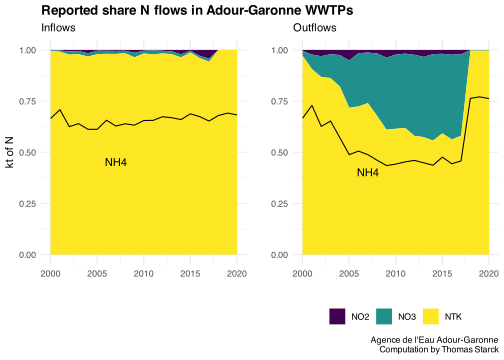
      title = "Reported share N flows in Adour-Garonne WWTPs",
      subtitle = "Inflows",
      caption=""
    ),
  #outflow
  ggplot(temp2) +
    geom_area(
      aes(
        Year, kt, 
        fill = N_type
        ),
      position="fill"
      ) +
    geom_line(
      data = basin_N_P_adour_garonne, 
      aes(
        Year, NH4_out/(NTK_out+NO3_out+NO2_out)
        )
      ) +
    theme(
      legend.position = "bottom", 
      legend.title = element_blank()
      ) +
    annotate(
      "text", label="NH4", 
      x=2007, y=0.4
      ) +
    labs(
      x="", y="", 
      title = "",
      subtitle = "Outflows",
      caption=Source
    ),
  align = "hv", axis="tblr"
)

Code
ggplot(basin_N_P_adour_garonne) +
  geom_line(aes(Year, NH4_in/NTK_in*100, color="inflow")) +
  geom_line(aes(Year, NH4_out/NTK_out*100, color="outflow")) +
  ylim(0, 100) +
  theme(legend.position = c(0.3, 0.3)) +
  labs(
    y="%", x="", color="",
    title = "Share of NH4 in NTK",
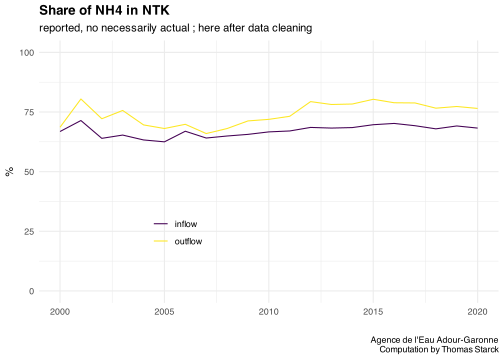
    subtitle = "reported, no necessarily actual ; here after data cleaning",
    caption=Source
    )

We compute in terms of installed capacity the reported and unreported flows for NGL, Pt, DBO5, DCO and MES. We do this for each year and for each capacity category.

Code
#create file of reported 
temp <- N_P_adour_garonne %>%
  select(
    Year, PE_bin, capacity, 
    Pt_in, Pt_out, NGL_in, NGL_out, DBO5_in, DBO5_out, DCO_in, DCO_out, MES_in, MES_out
    ) %>%
  #spots unreported values for each nutrient flow
  mutate(
    across(
      c(Pt_in, Pt_out, NGL_in, NGL_out, DBO5_in, DBO5_out, DCO_in, DCO_out, MES_in, MES_out),
      ~ is.na(.x)==F
      )
    ) %>%
  #gather to ba able to then group by flow and count capacity
  gather(
    key=nutrient_flow, 
    value = reported_pollution, 
    Pt_in, Pt_out, NGL_in, NGL_out, DBO5_in, DBO5_out, DCO_in, DCO_out, MES_in, MES_out
    )  %>%
  #count reported capacity and unreported capacity for each (Year, capacity category, nutrient flow)
  group_by(
    Year, PE_bin, nutrient_flow, reported_pollution
    ) %>%
  summarise(
    capacity = sum(capacity, na.rm=T)/10^6
    ) %>%
  #creates reported/unreported names for each nutrient flow and spreads into columns
  mutate(
    nutrient_flow = case_when(
      reported_pollution == T ~ paste0(nutrient_flow, "_reported"),
      reported_pollution == F ~ paste0(nutrient_flow, "_unreported")
    )
  ) %>%
  select(-reported_pollution) %>%
  spread(nutrient_flow, capacity)

# NA values replaced by 0 for future coeff computation
temp[is.na(temp)] <- 0

From this we compute proportionate coefficient to extrapolate real flows.

Code
temp <- temp %>%
  mutate(
    #Pt
    Pt_in_coeff = (Pt_in_reported + Pt_in_unreported)/Pt_in_reported,
    Pt_out_coeff = (Pt_out_reported + Pt_out_unreported)/Pt_out_reported,
    #NGL
    NGL_in_coeff = (NGL_in_reported + NGL_in_unreported)/NGL_in_reported,
    NGL_out_coeff = (NGL_out_reported + NGL_out_unreported)/NGL_out_reported,
    #DBO5
    DBO5_in_coeff = (DBO5_in_reported + DBO5_in_unreported)/DBO5_in_reported,
    DBO5_out_coeff = (DBO5_out_reported + DBO5_out_unreported)/DBO5_out_reported,
    #DCO
    DCO_in_coeff = (DCO_in_reported + DCO_in_unreported)/DCO_in_reported,
    DCO_out_coeff = (DCO_out_reported + DCO_out_unreported)/DCO_out_reported,
    #MES
    MES_in_coeff = (MES_in_reported + MES_in_unreported)/MES_in_reported,
    MES_out_coeff = (MES_out_reported + MES_out_unreported)/MES_out_reported,
  ) %>%
  select(
    -c(
      Pt_in_reported, Pt_in_unreported,
      Pt_out_reported, Pt_out_unreported,
      NGL_in_reported, NGL_in_unreported,
      NGL_out_reported, NGL_out_unreported,
      DBO5_in_reported, DBO5_in_unreported,
      DBO5_out_reported, DBO5_out_unreported,
      DCO_in_reported, DCO_in_unreported, 
      DCO_out_reported, DCO_out_unreported, 
      MES_in_reported, MES_in_unreported, 
      MES_out_reported, MES_out_unreported
      )
    )

#replace Inf values by 1 (when divided by 0)
temp[temp == Inf] <- 1
#replace NAN values by 1 (case of the unerported capacities)
temp[is.na(temp)] <- 1

With these coefficients we compute the adjusted flows

Code
#file with reported flows and adjustment coefficient
temp2 <- left_join(
  basin_PE_N_P_adour_garonne %>%
    #selects only flows and not yields or ratios
    select(
      Year, PE_bin, 
      Pt_in, Pt_out, NGL_in, NGL_out, DBO5_in, DBO5_out, DCO_in, DCO_out, MES_in, MES_out
    ),
  temp, by=c("Year", "PE_bin")
)

#computes adjusted flows
temp2 <- temp2 %>%
  mutate(
    #Pt
    Pt_in_adj = round(Pt_in_coeff*Pt_in, 5),
    Pt_out_adj = round(Pt_out_coeff*Pt_out, 5),
    #NGL
    NGL_in_adj = round(NGL_in_coeff*NGL_in, 5),
    NGL_out_adj = round(NGL_out_coeff*NGL_out, 5),
    #DBO5
    DBO5_in_adj = round(DBO5_in_coeff*DBO5_in, 5),
    DBO5_out_adj = round(DBO5_out_coeff*DBO5_out, 5),
    #DCO
    DCO_in_adj = round(DCO_in_coeff*DCO_in, 5),
    DCO_out_adj = round(DCO_out_coeff*DCO_out, 5),
    #MES
    MES_in_adj = round(MES_in_coeff*MES_in, 5),
    MES_out_adj = round(MES_out_coeff*MES_out, 5)
  ) %>%
  #we remove coefficients and unajusted flows
  select(
    -c(
      Pt_in, Pt_in_coeff, Pt_out, Pt_out_coeff,
      NGL_in, NGL_in_coeff, NGL_out, NGL_out_coeff,
      DBO5_in, DBO5_in_coeff, DBO5_out, DBO5_out_coeff,
      DCO_in, DCO_in_coeff, DCO_out, DCO_out_coeff, 
      MES_in, MES_in_coeff, MES_out, MES_out_coeff
    )
  )

We add these adjusted flows to the main files reporting flows at the basin scale

Code
#adding adjusted flows to the basin x capacity files
basin_PE_N_P_adour_garonne <- left_join(
  basin_PE_N_P_adour_garonne, temp2, by=c("Year", "PE_bin")
)

#aggregating adjusted flows at the basin scale without the capacity categories
temp <- temp2 %>%
  select(-PE_bin) %>%
  group_by(Year) %>%
  summarise_all(~signif(sum(.x), 3))

#adding adjusted flows to the basin files
basin_N_P_adour_garonne <- left_join(
  basin_N_P_adour_garonne, temp, by="Year"
)

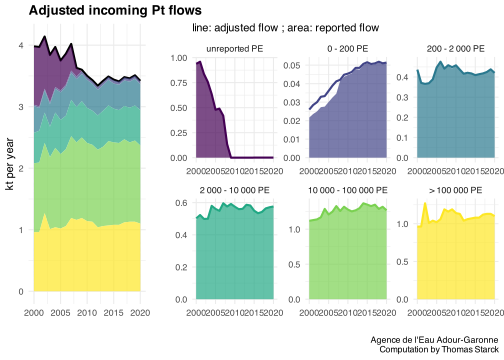
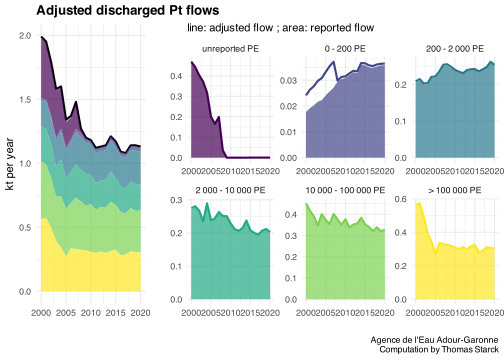
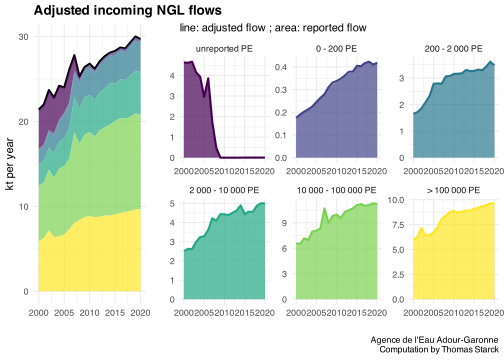
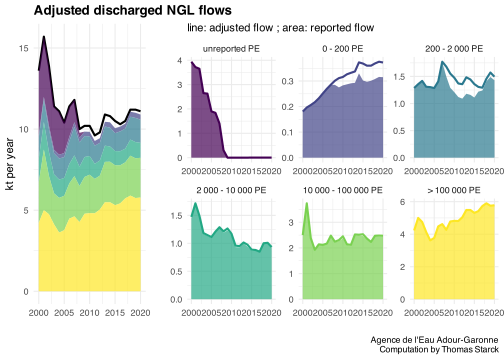
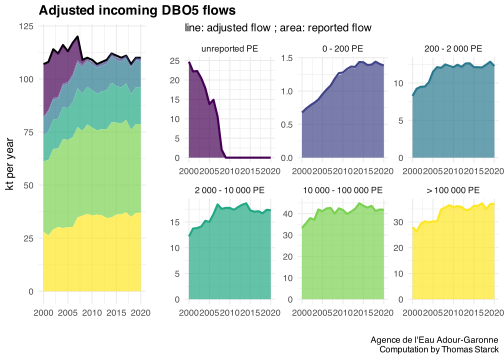
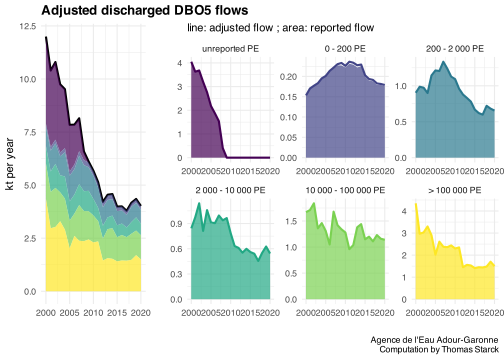
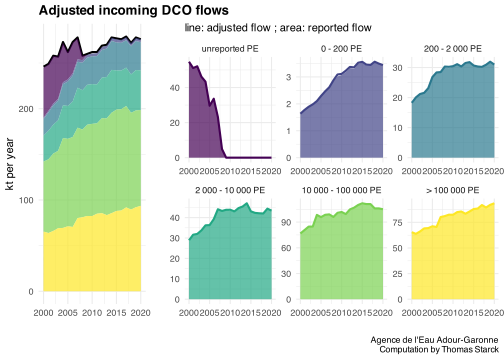
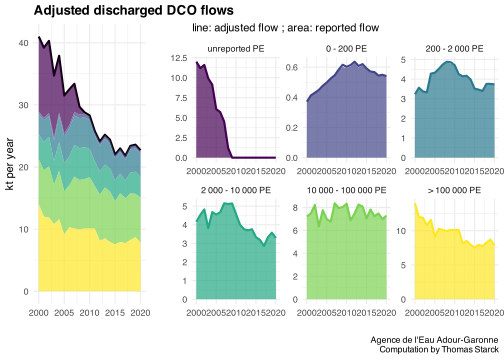
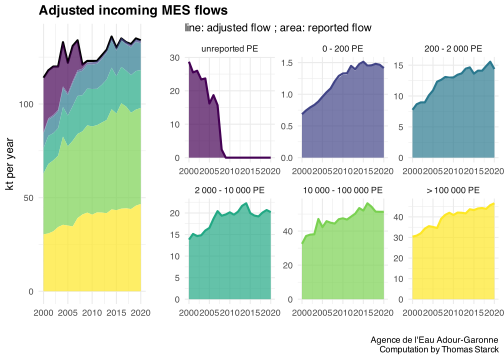
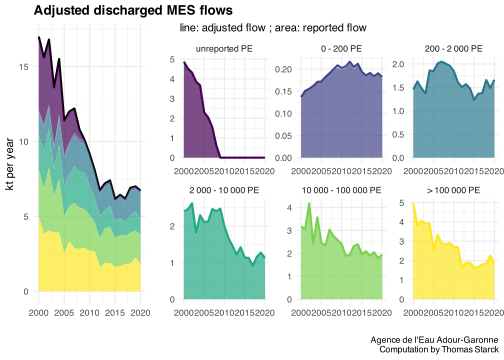
We plot the comparison reported / adjusted in the following graphs. For the Adour-Garonne basin, there is virtually no difference, except for NGL discharge.

Code
f_graph_adjusted <- function(basin_file, basin_PE_file, nutrient_adjusted, nutrient_reported, nutrient_label){
  g <- plot_grid(
    ggplot(basin_PE_file) +
      geom_line(
        data = basin_file,
        aes(Year, !!as.symbol(nutrient_adjusted)), 
        color="black", size=1
        ) + 
      geom_area(
        aes(Year, !!as.symbol(nutrient_reported), fill=PE_bin), 
        alpha=.7
        ) + 
      theme(legend.position = "none") +
      labs(
        x="", y="kt per year",
        caption = "\n",
        title = paste("Adjusted", nutrient_label, "flows")
    ),
    ggplot(basin_PE_file) +
      geom_line(
        aes(Year, !!as.symbol(nutrient_adjusted), color=PE_bin), 
        size=1
        ) + 
      geom_area(
        aes(Year, !!as.symbol(nutrient_reported), fill=PE_bin), 
        alpha=.7
        ) + 
      theme(legend.position = "none") +
      facet_wrap(vars(PE_bin), scales="free") +
      labs(
        x="", y="",
        caption = Source,
        title = "",
        subtitle = "line: adjusted flow ; area: reported flow"
      ),
    rel_widths = c(0.3, 0.7)
  )
  return(g)
}
Code
f_graph_adjusted(
  basin_N_P_adour_garonne, 
  basin_PE_N_P_adour_garonne,
  "Pt_in_adj", "Pt_in", "incoming Pt"
  )

Code
f_graph_adjusted(
  basin_N_P_adour_garonne, 
  basin_PE_N_P_adour_garonne,
  "Pt_out_adj", "Pt_out", "discharged Pt"
  )

Code
f_graph_adjusted(
  basin_N_P_adour_garonne, 
  basin_PE_N_P_adour_garonne,
  "NGL_in_adj", "NGL_in", "incoming NGL"
  )

Code
f_graph_adjusted(
  basin_N_P_adour_garonne, 
  basin_PE_N_P_adour_garonne,
  "NGL_out_adj", "NGL_out", "discharged NGL"
  )

Code
f_graph_adjusted(
  basin_N_P_adour_garonne, 
  basin_PE_N_P_adour_garonne,
  "DBO5_in_adj", "DBO5_in", "incoming DBO5"
  )

Code
f_graph_adjusted(
  basin_N_P_adour_garonne, 
  basin_PE_N_P_adour_garonne,
  "DBO5_out_adj", "DBO5_out", "discharged DBO5"
  )

Code
f_graph_adjusted(
  basin_N_P_adour_garonne, 
  basin_PE_N_P_adour_garonne,
  "DCO_in_adj", "DCO_in", "incoming DCO"
  )

Code
f_graph_adjusted(
  basin_N_P_adour_garonne, 
  basin_PE_N_P_adour_garonne,
  "DCO_out_adj", "DCO_out", "discharged DCO"
  )

Code
f_graph_adjusted(
  basin_N_P_adour_garonne, 
  basin_PE_N_P_adour_garonne,
  "MES_in_adj", "MES_in", "incoming MES"
  )

Code
f_graph_adjusted(
  basin_N_P_adour_garonne, 
  basin_PE_N_P_adour_garonne,
  "MES_out_adj", "MES_out", "discharged MES"
  )

Discharge without treatment

Just a few stations report the direct discharges of pollution. See in the previous section Pollution flows -> Data Quality: reporting rates. In the 2015-2020, only about ~10% of stations reported direct discharges, but they represent about ~50% of the total installed capacity.

There are 3 indicators for direct discharges.

  • before 2015 estimation of A1 + A2 points discharges, (original variable PORMX, renamed ._discharge_estimate in our code);
  • the direct discharges from sewers, corresponding to A1 point (original variable PORDO, renamed ._collection_discharge in our code).
  • the direct discharge just before the WWTP, corresponding to the A2 point (original variable PORBP, renamed ._head_by_pass in our code).
  • apparently the French “A5 point” is not reported (it seems to be already included in the outflow pollution).

In the following tab we represent these direct discharges as % of inflow in WWTP, for the WWTP where both flows are reported.

Here we see a consistent continuity between the pre-2015 estimations and ours for 2015-2020. However for proper estimation, we need to weight the flows by the number of days (per month) when a direct discharge is effectively made. This is done in the next tabs Adjusted by nb of discharge days.

Code
#selects discharged flows and compares them to incoming flows
f_select_nutrient_discharge <- function(nutrient){
  #creates nutrient variable names
  x_collection_discharge <- paste0(nutrient, "_collection_discharge")
  x_head_by_pass <- paste0(nutrient, "_head_by_pass")
  x_discharge_estimate <- paste0(nutrient, "_discharge_estimate")
  x_in <- paste0(nutrient, "_in")
  
  #only A1 points, (PORDO, renamed _collection_discharge)
  temp <- N_P_adour_garonne %>%
    #only if both A1 point and incoming flow reported
    filter(is.na(!!as.symbol(x_collection_discharge))==F & is.na(!!as.symbol(x_in))==F) %>%
    group_by(Year) %>%
    summarise(
      collection_discharge = sum(!!as.symbol(x_collection_discharge), na.rm=T),
      incoming = sum(!!as.symbol(x_in), na.rm=T),
      perc_collection_discharge = collection_discharge/incoming*100
    )
  #A2 point, (PORBP, renamed _head_by_pass)
  temp1 <- N_P_adour_garonne %>%
    #only if both A2 point and incoming flow reported
    filter(is.na(!!as.symbol(x_head_by_pass))==F & is.na(!!as.symbol(x_in))==F) %>%
    group_by(Year) %>%
    summarise(
      head_by_pass = sum(!!as.symbol(x_head_by_pass), na.rm=T),
      incoming = sum(!!as.symbol(x_in), na.rm=T),
      perc_head_by_pass = head_by_pass/incoming*100
    )
  #combine A1 and A2 points
  temp <- left_join(
    temp %>% select(Year, perc_collection_discharge),
    temp1 %>% select(Year, perc_head_by_pass),
    by="Year"
    ) %>%
    gather(
      point, value, perc_head_by_pass, perc_collection_discharge
    ) %>%
    mutate(
      point = case_when(
        point=="perc_head_by_pass"~"A2 point",
        point=="perc_collection_discharge"~"A1 point",
      )
    )
  
  #estimate total before 2015, PORMX (renamed ._discharge_estimate)
  temp1 <- N_P_adour_garonne %>%
    #only if both estimation and incoming flow reported
    filter(is.na(!!as.symbol(x_discharge_estimate))==F & is.na(!!as.symbol(x_in))==F) %>%
    group_by(Year) %>%
    summarise(
      discharge_estimate = sum(!!as.symbol(x_discharge_estimate), na.rm=T),
      incoming = sum(!!as.symbol(x_in), na.rm=T),
      perc_discharge_estimate = discharge_estimate/incoming*100
    )
  
  return(list(temp1, temp))
}

#function for graph
f_graph_direct_disharge <- function(temp, nutrient){
  g <- ggplot(temp[[1]]) +
    geom_line(
      aes(Year, perc_discharge_estimate, color="A1+A2, before 2015"),
      ) +
    scale_color_manual(values = c("black")) +
    geom_area(
      data = temp[[2]], alpha=.8,
      aes(Year, value, fill=point)
      ) +
    theme(legend.title = element_blank()) +
    labs(
      x="", y="%",
      title=paste0("Direct discharge of ", nutrient, " (unajusted !)"),
      subtitle = "% of WWTP inflow (A3 point)",
      caption = Source
      )
  return(g)
}
Code
temp <- f_select_nutrient_discharge("Pt")
f_graph_direct_disharge(temp, "Pt")

Code
temp <- f_select_nutrient_discharge("NGL")
f_graph_direct_disharge(temp, "NGL")

Code
temp <- f_select_nutrient_discharge("DBO5")
f_graph_direct_disharge(temp, "DBO5")

Code
temp <- f_select_nutrient_discharge("DCO")
f_graph_direct_disharge(temp, "DCO")

Code
temp <- f_select_nutrient_discharge("MES")
f_graph_direct_disharge(temp, "MES")

The number of days of direct discharge (used to ajust flows) are only reported for 2015-2020 for direct discharges from sewers (A2 point) and 2018-2020 for direct discharge just before the WWTP (A2 point). The result is that for 2018-2020, direct discharges in A1 and A2 points represent 5-6% of the WWTP incoming pollution.

Code
#selects discharged flows and compares them to incoming flows
f_select_nutrient_discharge_adj <- function(nutrient){
  #creates nutrient variable names
  x_collection_discharge <- paste0(nutrient, "_collection_discharge")
  x_head_by_pass <- paste0(nutrient, "_head_by_pass")
  x_discharge_estimate <- paste0(nutrient, "_discharge_estimate")
  x_in <- paste0(nutrient, "_in")
  
  #only A1 points, (PORDO, renamed _collection_discharge)
  temp <- N_P_adour_garonne %>%
    #only if A1 point, nb of days and incoming flow are all reported
    filter(is.na(!!as.symbol(x_collection_discharge))==F & is.na(!!as.symbol(x_in))==F & is.na(NBJDV_collection_discharge)==F) %>%
    mutate(collection_discharge = !!as.symbol(x_collection_discharge)*NBJDV_collection_discharge/30) %>%
    group_by(Year) %>%
    summarise(
      collection_discharge = sum(collection_discharge, na.rm=T),
      incoming = sum(!!as.symbol(x_in), na.rm=T),
      perc_collection_discharge = collection_discharge/incoming*100
    )
  #A2 point, (PORBP, renamed _head_by_pass)
  temp1 <- N_P_adour_garonne %>%
    #only if A2 point, nb of days and incoming flow are all reported
    filter(is.na(!!as.symbol(x_head_by_pass))==F & is.na(!!as.symbol(x_in))==F & is.na(NBJDV_A2)==F) %>%
    mutate(head_by_pass = !!as.symbol(x_head_by_pass)*NBJDV_A2/30) %>%
    group_by(Year) %>%
    summarise(
      head_by_pass = sum(head_by_pass, na.rm=T),
      incoming = sum(!!as.symbol(x_in), na.rm=T),
      perc_head_by_pass = head_by_pass/incoming*100
    )
  #combine A1 and A2 points
  temp <- left_join(
    temp %>% select(Year, perc_collection_discharge),
    temp1 %>% select(Year, perc_head_by_pass),
    by="Year"
    ) %>%
    gather(
      point, value, perc_head_by_pass, perc_collection_discharge
    ) %>%
    mutate(
      point = case_when(
        point=="perc_head_by_pass"~"A2 point",
        point=="perc_collection_discharge"~"A1 point",
      )
    )
  
  return(temp)
}

#function for graph
f_graph_direct_disharge_adj <- function(temp, nutrient){
  temp$point <- 
    factor(
      temp$point, 
      levels = 
        c("A2 point", "A1 point")
        )
  
  g <- ggplot(temp) +
    geom_area(
      alpha=.8,
      aes(Year, value, fill=point)
      ) +
    theme(legend.title = element_blank()) +
    labs(
      x="", y="%",
      title=paste0("Direct discharge of ", nutrient),
      subtitle = "% of WWTP inflow (A3 point)",
      caption = Source
      )
  return(g)
}
Code
temp <- f_select_nutrient_discharge_adj("Pt")
f_graph_direct_disharge_adj(temp, "Pt")

Code
temp <- f_select_nutrient_discharge_adj("NGL")
f_graph_direct_disharge_adj(temp, "NGL")

Code
temp <- f_select_nutrient_discharge_adj("DBO5")
f_graph_direct_disharge_adj(temp, "DBO5")

Code
temp <- f_select_nutrient_discharge_adj("DCO")
f_graph_direct_disharge_adj(temp, "DCO")

Code
temp <- f_select_nutrient_discharge_adj("MES")
f_graph_direct_disharge_adj(temp, "MES")

Ratios

Code
#temporal P/N ratio
ggplot(basin_N_P_adour_garonne) + 
  geom_line(aes(Year, N_P_ratio_in, color="N:P in")) + 
  geom_line(aes(Year, N_P_ratio_out, color = "N:P out")) + 
  ylim(0, NA) +
  theme(
    legend.position = c(0.7, 0.6)
  ) +
  labs(
    x="", y="N:P ratio",
    title = "N:P ratio in Adour-Garonne basin",
    subtitle = "increase over time reflect phosphate detergent ban",
    caption=Source, color=""
  )

Code
ggplot(basin_N_P_adour_garonne) + 
  geom_line(aes(Year, DCO_in/DBO5_in, color="DCO:DBO5 in")) + 
  geom_line(aes(Year, DCO_out/DBO5_out, color = "DCO:DBO5 out")) + 
  ylim(0, NA) +
  theme(
    legend.position = c(0.7, 0.6)
  ) +
  labs(
    x="", y="DCO:DBO5 ratio",
    title = "DCO:DBO5 ratio in Adour-Garonne basin",
    subtitle = "decrease in outflow shows biodegradation",
    caption=Source, color=""
  )

Code
ggplot(basin_N_P_adour_garonne) + 
  geom_point(
    aes(
      DBO5_in/NGL_in, DBO5_in/Pt_in, 
      color=Year_category
      )
    ) +
  geom_point(
    aes(
      DBO5_out/NGL_out, DBO5_out/Pt_out, 
      color=Year_category
        )
    ) +
  ylim(0, NA) +
  annotate(
    geom="text", label ="inflow",
    x=4, y=25
  ) +
  annotate(
    geom="text", label ="outflow",
    x=1.3, y=8
  ) +
  labs(
    x="DBO5:Pt ratio", y="DBO5:NGL ratio",
    title = "DBO5:NGL vs DBO5:Pt ratio in Adour-Garonne basin WWTPs",
    subtitle = "decrease in outflow shows biodegradation",
    caption=Source, color=""
  )

Basin yield

Code
ggplot(basin_N_P_adour_garonne) + 
  geom_line(aes(Year, Pt_yield, color="P")) + 
  geom_line(aes(Year, NGL_yield, color = "N")) + 
  geom_line(aes(Year, DBO5_yield, color = "DBO5")) +
  geom_line(aes(Year, DCO_yield, color = "DCO")) +
  geom_line(aes(Year, MES_yield, color = "MES")) +
  ylim(0,100) +
  theme(legend.position = c(0.7, 0.3)) +
  labs(
    title = "Global abatement rate of Adour-Garonne WWTPs", 
    x="", y="Yield (%)", color="",
    caption = Source
    )

Code
f_graph_yield_PE <- function(dataset, nutrient_yield, nutrient_label){
  g <- ggplot(dataset %>% filter(PE_bin !="unreported PE")) + 
    geom_line(aes(Year, !!as.symbol(nutrient_yield), color=PE_bin)) + 
    ylim(0,100) +
    theme(legend.position = c(0.7, 0.3)) +
    labs(
      title = paste("Global", nutrient_label, "yield of Adour-Garonne basin"), 
      subtitle = "by capacity (population equivalent)",
      x="", y="Yield (%)", color="",
      caption = Source
      )
  return(g)
}
Code
f_graph_yield_PE(
  basin_PE_N_P_adour_garonne %>% filter(PE_bin!="0 - 200 PE"), 
  "Pt_yield", "Pt")

Code
f_graph_yield_PE(
  basin_PE_N_P_adour_garonne %>% filter(PE_bin!="0 - 200 PE"), 
  "NGL_yield", "NGL")

Code
f_graph_yield_PE(
  basin_PE_N_P_adour_garonne %>% filter(PE_bin!="0 - 200 PE"), 
  "DBO5_yield", "DBO5")

Code
f_graph_yield_PE(
  basin_PE_N_P_adour_garonne %>% filter(PE_bin!="0 - 200 PE"), 
  "DCO_yield", "DCO")

Code
f_graph_yield_PE(
  basin_PE_N_P_adour_garonne %>% filter(PE_bin!="0 - 200 PE"), 
  "MES_yield", "MES")

Save data

We save the corrected data.

Code
#all WWTP file
path_output <- "output_data/all_WWTP/"
temp <- N_P_adour_garonne %>%
  select(
    code_WWTP, name_WWTP, Year, capacity, name_commune, INSEE_COM, lat_WWTP, long_WWTP, PE_bin,
    DBO5_in, DCO_in, MES_in, NGL_in, NTK_in, NH4_in, NO3_in, NO2_in, Pt_in,
    DBO5_out, DCO_out, MES_out, NGL_out, NTK_out, NH4_out, NO3_out, NO2_out, Pt_out,
    DBO5_yield, DCO_yield, MES_yield, NGL_yield, Pt_yield,
  )
f_save_csv_files(
  temp,
  path_output,
  "all_WWTP_05_adour_garonne.csv"
)

#basin agregated file
path_output <- "output_data/basins/"
temp <- basin_N_P_adour_garonne %>%
  select(
    Year, capacity, nb_WWTP,
    #flows reported and adjusted
    Pt_in, Pt_in_adj, NGL_in, NGL_in_adj, 
    DBO5_in, DBO5_in_adj, DCO_in, DCO_in_adj, MES_in, MES_in_adj,
    Pt_out, Pt_out_adj, NGL_out, NGL_out_adj,
    DBO5_out, DBO5_out_adj, DCO_out, DCO_out_adj, MES_out, MES_out_adj,
    #yields
    NGL_yield, Pt_yield, DBO5_yield, DCO_yield, MES_yield, 
    #nutrient ratios
    N_P_ratio_in, N_P_ratio_out,
    DBO5_N_ratio_in, DBO5_N_ratio_out, DBO5_P_ratio_in, DBO5_P_ratio_out,
    DCO_N_ratio_in, DCO_N_ratio_out, DCO_P_ratio_in, DCO_P_ratio_out,
    DCO_DBO5_ratio_in, DCO_DBO5_ratio_out,
    #PE ratios
    Pt_PE_ratio_in, Pt_PE_ratio_out, NGL_PE_ratio_in, NGL_PE_ratio_out, 
    DBO5_PE_ratio_in, DBO5_PE_ratio_out, DCO_PE_ratio_in, DCO_PE_ratio_out, MES_PE_ratio_in, MES_PE_ratio_out
  )
f_save_csv_files(
  temp,
  path_output,
  "basin_05_adour_garonne.csv"
)

#basin x PE agregated file
path_output <- "output_data/basins_PE/"
temp <- basin_PE_N_P_adour_garonne %>%
  select(
    Year, capacity, nb_WWTP, PE_bin, 
    #flows reported and adjusted
    Pt_in, Pt_in_adj, NGL_in, NGL_in_adj, 
    DBO5_in, DBO5_in_adj, DCO_in, DCO_in_adj, MES_in, MES_in_adj,
    Pt_out, Pt_out_adj, NGL_out, NGL_out_adj,
    DBO5_out, DBO5_out_adj, DCO_out, DCO_out_adj, MES_out, MES_out_adj,
    #yields
    NGL_yield, Pt_yield, DBO5_yield, DCO_yield, MES_yield, 
    #nutrient ratios
    N_P_ratio_in, N_P_ratio_out,
    DBO5_N_ratio_in, DBO5_N_ratio_out, DBO5_P_ratio_in, DBO5_P_ratio_out,
    DCO_N_ratio_in, DCO_N_ratio_out, DCO_P_ratio_in, DCO_P_ratio_out,
    DCO_DBO5_ratio_in, DCO_DBO5_ratio_out,
    #PE ratios
    Pt_PE_ratio_in, Pt_PE_ratio_out, NGL_PE_ratio_in, NGL_PE_ratio_out, 
    DBO5_PE_ratio_in, DBO5_PE_ratio_out, DCO_PE_ratio_in, DCO_PE_ratio_out, MES_PE_ratio_in, MES_PE_ratio_out
  )
f_save_csv_files(
  temp,
  path_output,
  "basin_PE_05_adour_garonne.csv"
)
Code
rm(list = ls())